


How Can’t Miss US Delivered 4.6M Impressions Across Ohio in 72 Hours—And Why That Matters


How Can’t Miss US Delivered 4.6M Impressions Across Ohio in 72 Hours—And Why That Matters
When Jobs Ohio came to Can’t Miss US with an announcement to make, they didn’t ask for a traditional billboard campaign. They wanted something that would stop people mid-day, cut through the noise of everyday commutes, and build real momentum leading up to a major reveal. Can’t Miss US built them exactly that: a coordinated mobile digital announcement that moved—literally—across three major Ohio metros simultaneously.
The campaign ran for just three days across Columbus, Cleveland, and Cincinnati. But the numbers tell a story about what digital mobile billboards can accomplish when deployment is coordinated at scale.
The campaign ran for just three days across Columbus, Cleveland, and Cincinnati. But the numbers tell a story about what digital mobile billboards can accomplish when deployment is coordinated at scale.
The Setup
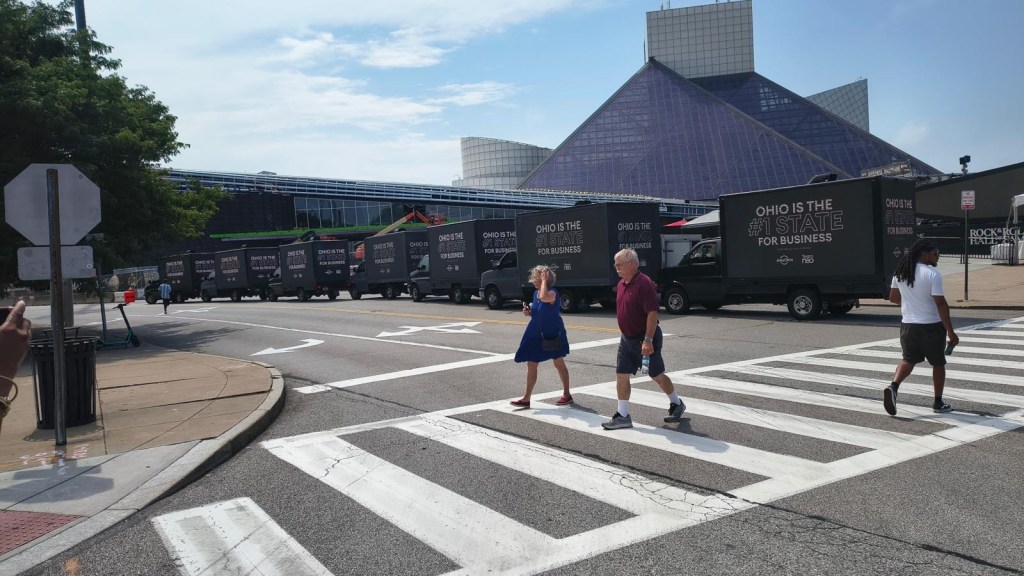
Jobs Ohio’s message was simple but intriguing: “Something BIG is coming” with a countdown timer ticking down to July 9 at 9:00 AM. The creative was bold and minimal—just the message, the timer, and the date—designed to create curiosity rather than answer questions. It was a teaser that lived on wheels.
Can’t Miss US deployed 17 of its trucks across three markets—a coordinated multi-market execution that’s only possible because Can’t Miss US operates the nation’s largest fleet of digital mobile billboards. In Columbus, five trucks hit the major arterials. Cleveland got seven trucks to cover their wider metro area. Cincinnati rounded it out with five more. Each truck had its own assigned routes but shared the same goal: create visible, auditable impressions during the critical days leading up to the announcement.
The Results Don’t Disappoint
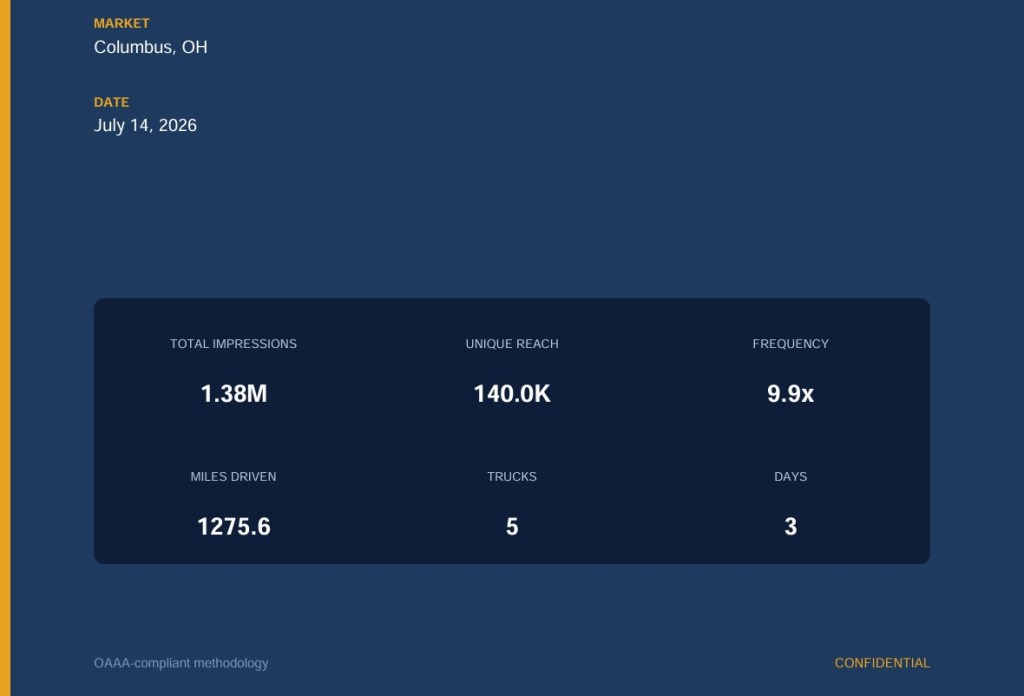
Columbus delivered 1.38 million OAAA-compliant impressions to 140,000 unique individuals, achieving a 9.9x frequency over three days.
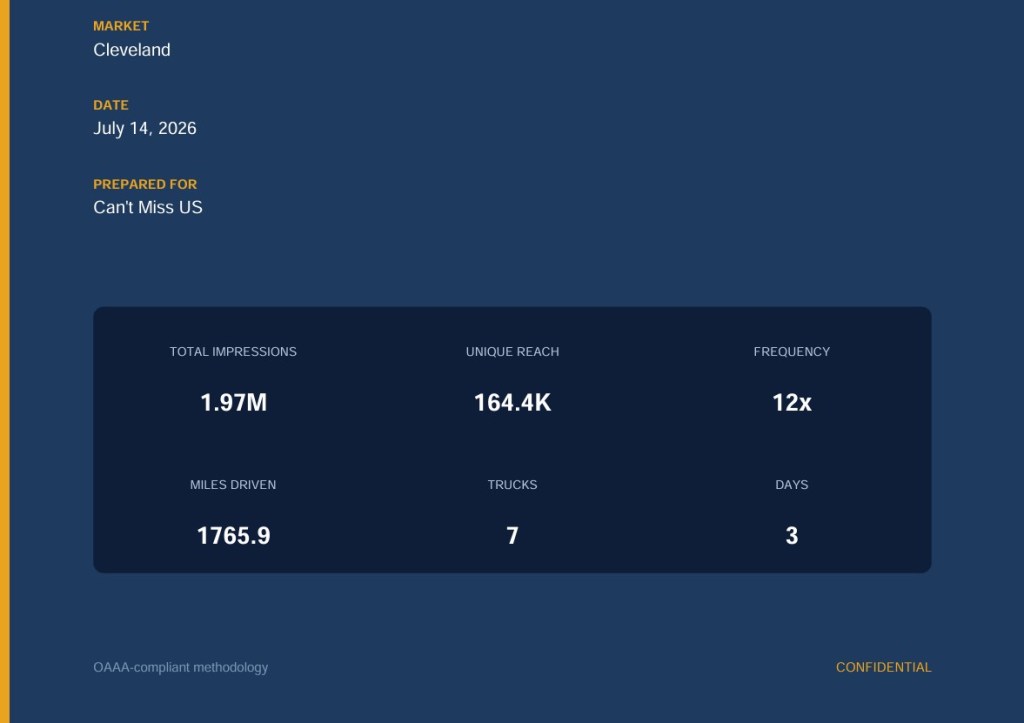
Cleveland ran hot, generating 1.97 million impressions and reaching 164,400 unique people at a 12x average frequency—the highest frequency of any market in the campaign.

Cincinnati posted 1.25 million impressions with 140,000 unique reach and an 8.9x frequency.
Combined across the three metros, we’re talking about 4.6 million impressions and 444,000+ unique individuals exposed to that countdown message in just 72 hours.
Synchronized Creative Across Three Markets: How Fleet Sync Play Made It Seamless
Here’s where the campaign gets interesting from an operations standpoint. Getting 17 trucks across three different cities to display the exact same creative at the exact same time is complicated. Keeping them all synchronized over three days—while each truck runs its own route, hits its own traffic patterns, and operates in its own market—is where most mobile digital campaigns fall apart.
That’s where Can’t Miss US‘s proprietary Fleet Sync Play technology comes in. This is the kind of operational capability you only get when you’re working with the nation’s largest mobile billboard fleet.
Jobs Ohio’s creative—that bold “Something BIG is coming” message with the live countdown timer—needed to feel like a coordinated movement, not a scattered effort. Using Fleet Sync Play, Can’t Miss US managed creative deployment and timing from a single control point. Every truck across Columbus, Cleveland, and Cincinnati was showing the same message at the same moment. No delays. No inconsistencies. No regional variations.
From a viewer’s perspective, this matters more than it might seem. When someone sees the campaign on Monday morning in Columbus, then sees the same message again on Wednesday in Cleveland, there’s a sense of inevitability. The message feels bigger. It feels coordinated. It feels like something real is actually happening—because something real is actually being coordinated.
From an operational standpoint, it means we didn’t have to manage three separate campaigns. We didn’t have to worry about one truck getting behind schedule and throwing off the messaging for a whole market. We deployed once. The creative ran across the entire 17-truck fleet in sync.
That synchronization is also what enabled us to push the countdown timer feature across all three markets. That timer needed to show the same time on every screen, updating in real-time. With Fleet Sync Play, the countdown was genuinely live and consistent. By July 9 at 9:00 AM, every viewer who’d been watching these trucks move through their city knew exactly when the announcement was happening.
Why Frequency Matters—And Why These Numbers Matter
Here’s something a lot of traditional OOH buyers miss: frequency isn’t just a vanity metric. When you’re building anticipation for a specific date and time, you need people to see it again. They need to see it on their morning commute. Again on the way to lunch. Maybe once more on the drive home. That repetition is what drives the conversation. It’s what makes people pull out their phones and look up what’s actually happening on July 9.
Our average frequency of nearly 10 times per person isn’t an accident. It comes from route coordination, understanding peak traffic patterns, and deploying trucks where they’ll actually be seen during the times when people are paying attention. The reports show the midday daypart (9am-4pm) carried 57 to 63 percent of total impressions across all markets. That’s peak engagement time. That’s when decision-makers are moving through the city.
The Dwell Effect
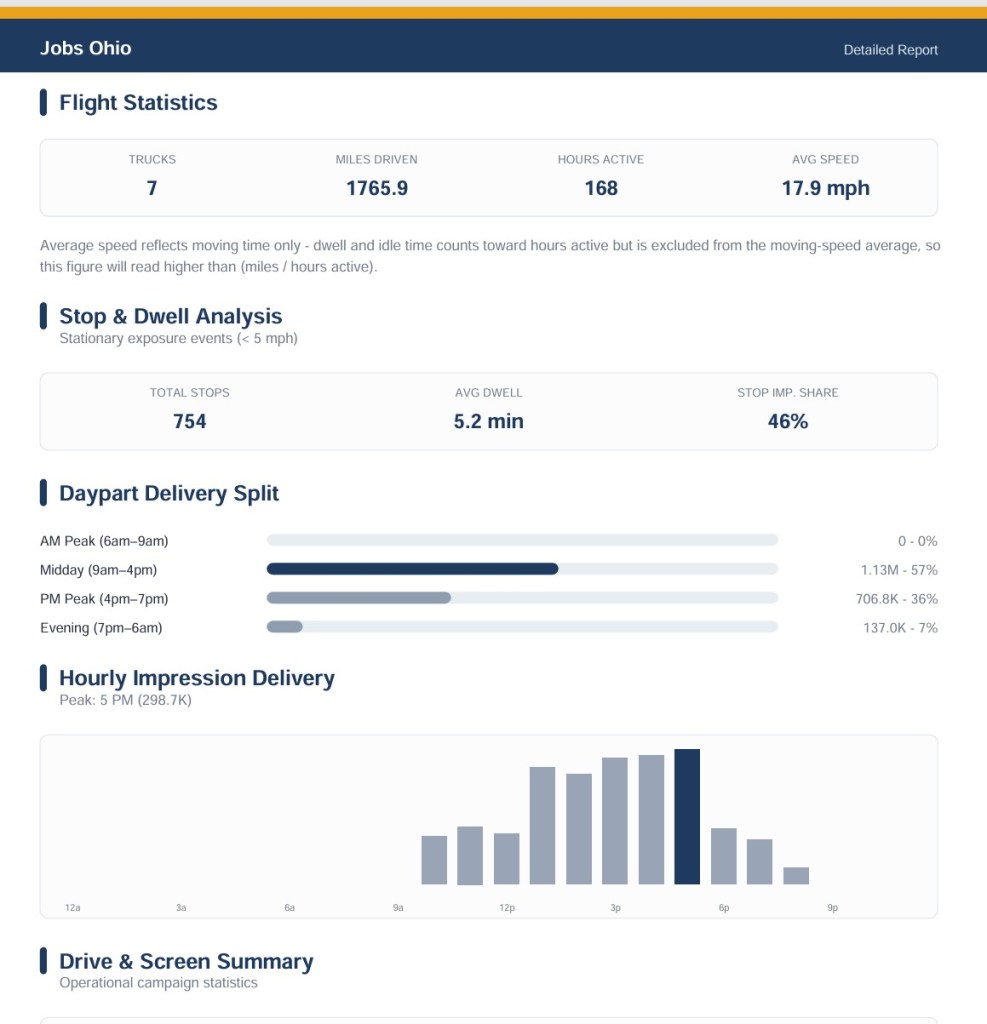
Something else worth noting: about half the impressions in this campaign came from dwell stops. The trucks weren’t just driving past people. They were parking in high-traffic areas—downtown corridors, near major employers, in commercial districts—and sitting there long enough for pedestrians to notice and really process the message. Columbus showed 47 percent of its impressions from stationary stops. Cleveland at 46 percent. Cincinnati at 48 percent. That’s not random. That’s a deliberate strategy.
Dwell time matters because it transforms a glimpse into a moment. Someone stuck in traffic might see your ad for two seconds. Someone walking through a downtown plaza can stop and look at it, read the message, check the date, and actually think about it. The photos from this campaign show that happening—real pedestrians, real engagement, people actually standing in front of the trucks, many of them pulling out phones to probably search for #jobsohio on the spot.
The Multi-Market Complexity
One thing people don’t always appreciate about a three-market campaign done simultaneously is the logistics. You need to coordinate routes so that all trucks are hitting their markets at the right times. You need weather data, traffic intelligence, and real-time adjustment capability. You need to know which streets matter most in each city. Cleveland’s Chester Avenue and Berea Freeway aren’t the same as Columbus’s Jack Nicklaus Freeway or Cincinnati’s Circle Freeway, but we had to make each network work within its own market context.
The reports show 100 percent road-data coverage across all three markets. Every single GPS ping was matched to actual traffic data. That’s OAAA-compliant methodology with no shortcuts.
What This Means for the Industry
If you’re a marketer or an agency working on announcement campaigns, there’s a lesson here: digital mobile billboards have moved beyond novelty into serious reach and frequency territory. This isn’t about one truck creating a stunt. This is about coordinated deployment across multiple major metros—exactly what Can’t Miss US executed for Jobs Ohio—delivering measurable, auditable impressions with real frequency behind them.
The clients who get the biggest results with mobile digital aren’t using them as a “nice to have.” They’re using them as a core component of a launch strategy. They understand that frequency builds momentum. They know that seeing an announcement in motion—literally moving through the city—creates a different psychological impact than a static board.
When you have access to the nation’s largest fleet of digital mobile billboards combined with proprietary coordination technology like Fleet Sync Play, you can execute what Jobs Ohio just did: announce across three major metros with 4.6 million auditable digital touches and real, deduped reach numbers. In three days.
The question isn’t whether mobile digital works for announcements. This campaign answers that. The question is whether you have the scale and coordination capability to execute it. Can’t Miss US does.
The Bottom Line
In an industry where a lot of campaigns are measured by clicks or views or “estimated reach,” it’s worth noting that everything in this campaign is OAAA-compliant. The numbers are audited. The methodology is transparent. The impressions are real—tied to actual traffic counts, measured driving routes, and GPS-verified data.
This is the kind of execution you get when you work with Can’t Miss US: coordinated, measurable, and built on 100+ trucks operating across 100+ U.S. markets. When you’re ready to move your announcement, your awareness campaign, or your brand moment, that’s the kind of certainty you want behind your media spend.
About Can’t Miss US: Can’t Miss US operates the nation’s largest fleet of LED-equipped digital mobile billboard trucks, deployed across 100+ U.S. markets. The company’s new feature, Fleet Sync Play, enables synchronized multi-market campaigns, real-time creative management, and OAAA-compliant impression tracking. For campaigns like Jobs Ohio that require coordinated scale, measurable reach, and proven frequency, Can’t Miss US delivers unmatched capability. Learn more at www.cantmiss.us.
About the Author:  Mizba Lakdawala-Sajan is a key leader at Can’t Miss US, home to the nation’s largest fleet of digital mobile billboard trucks. With a massive network operating in every major market across the country, the company is dedicated to transforming traditional advertising into a high-tech, street-level experience.


- Advertisement -

