


Chasing the Crowd —by Aubrey Lundgren, Lime Media
Lime Media: What electrolytic's FIFA Campaign Proved About Mobile OOH


 Chasing the Crowd:
What electrolytic’s FIFA Campaign Proved About Mobile OOH

by Aubrey Lundgren, Lime Media | OOH Today
There’s a fundamental tension at the heart of out-of-home advertising that the industry has largely learned to live with: the audience moves, but the media doesn’t. A billboard on a highway captures whoever happens to drive past on any given day. If the crowd shifts to a new neighborhood, a new venue, a new cultural moment, the billboard stays exactly where it is.
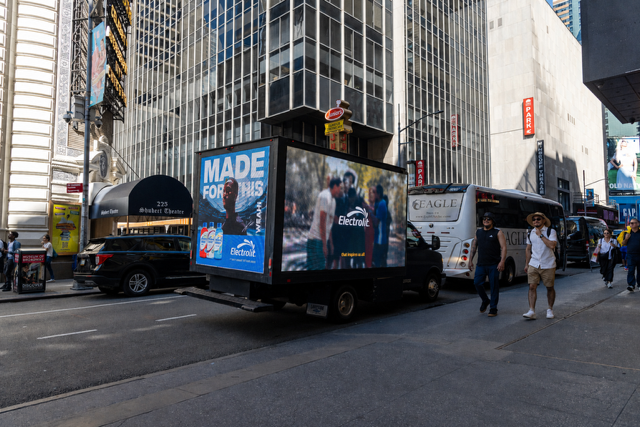
Mobile LED billboard truck advertising was built to resolve that tension. And this summer, electrolytic’s FIFA World Cup campaign demonstrated exactly what that resolution looks like in practice.
The Brief: Be Where the Energy Is
When electrolytic, the number one rapid hydration beverage and official sponsor of the U.S. Men’s National Soccer Team, set out to activate during the World Cup, the challenge wasn’t awareness. It was presence. How do you put a brand in front of millions of passionate, energized fans across multiple major markets, in the specific places where World Cup energy was actually concentrated, without being locked into fixed placements that may or may not align with where crowds are gathering on any given day?
The answer was mobile billboard LED trucks, and the strategy was simple in concept but demanding in execution: don’t wait for the crowd. Chase it.
Working with agency partner Dash Two and operating through Lime Media’s expansive fleet, electrolytic deployed LED billboard trucks across three of the tournament’s biggest host markets between June 12 and July 19. Rather than committing to fixed locations, routes were built dynamically around where World Cup energy was highest on each activation day, the Hollywood Walk of Fame in LA, the dense pedestrian zones near NYC’s Fan Fest crowds, and the blocks surrounding Globe Life Field and Reunion Tower in Dallas-Arlington.
The Numbers: No Dead Days
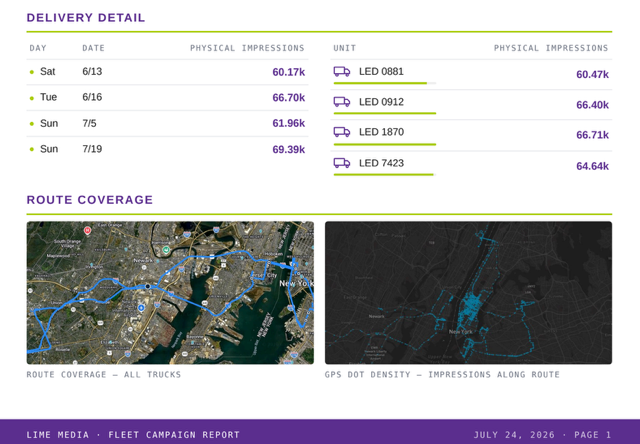
Over five weeks and eight activation days, the campaign delivered 629,220 total physical impressions across three markets, an average of more than 83,000 impressions per activation day, with every single market clearing 60,000+ impressions on its lowest performance day.
The market-by-market breakdown tells its own story:
New York: 4 trucks, 4 activation days | 258,220 impressions
Los Angeles: 3 trucks, 2 activation days | 184,810 impressions
Dallas: 4 trucks, 2 activation days | 186,190 impressions
Three different cities. Three different route structures. Three different truck counts. And remarkably consistent daily performance across all of them- no market had a dead day. That consistency isn’t accidental. It’s the result of audience-led route planning, real-time operational flexibility, and market-level infrastructure that allows a campaign to actually move with the moment rather than hope the moment comes to it.
What This Campaign Proved About the Format
Two things stood out from the electrolytic campaign that speak directly to what makes mobile OOH perform at its highest level.
The first is the power of flexibility. Because Lime Media’s LED trucks aren’t locked to a single location, the fleet could route to wherever World Cup crowds were concentrated on a given activation day, adjusting in real time to event schedules, fan zone activity, and market energy. That turns a media buy into something closer to a live tactical decision. It’s a level of responsiveness that requires not just the right vehicles, but the right planning infrastructure, the right operational team, and the right data informing every routing decision before the truck ever leaves the lot.
The second is the strategic alignment between format and moment. For a hydration brand like electrolytic, the World Cup wasn’t just a cultural event, it was a direct line to an audience already primed to be thinking about performance, recovery, and the physical demands of athletic competition. Mobile LED didn’t just put the brand in front of that audience. It put the brand in the middle of the moments those consumers were already experiencing: on the streets, outside fan zones, in the neighborhoods where the tournament was actually being lived.
The Infrastructure Behind the Performance
Here’s where the format conversation gets important, because mobile OOH’s promise of flexibility is only as good as the infrastructure behind it.
Real scale requires owned and operated fleet across multiple DMAs, route planning built on audience intelligence, and verified impression reporting tied to GPS-traced routes. It requires the operational capability to execute consistently across three different markets in the same campaign window, adjusting in real time without sacrificing daily performance in any of them.
The brands and agencies leading the next era of OOH aren’t just asking whether a vendor has trucks available. They’re asking whether the operator has the data infrastructure to plan smarter routes, the operational depth to execute across markets simultaneously, and the measurement capability to verify every impression delivered. Those are the questions that separate a media buy that runs from a media buy that performs.
Lime Media’s network of 80+ owned and operated LED billboard trucks across 50+ DMAs is what made the electrolytic campaign possible: consistent delivery across New York, Los Angeles, and Dallas-Arlington simultaneously, with verified impressions and real-time route optimization in every market. Not a capability to aspire to. A platform already in market, already delivering.
The operator behind the truck determines whether the campaign performs. electrolytic’s results are the proof.
The Takeaway
629,220 impressions. Three markets. Eight activation days. No dead days. A campaign built around real-time event energy rather than fixed placements, and results that reflect exactly what happens when a brand pairs a cultural moment with a media format purpose-built to move with it.
Mobile OOH has always promised flexibility. The electrolytic FIFA campaign delivered proof. The crowd is always moving. The question now is whether your media plan is built to move with it.
The Takeaway
629,220 impressions. Three markets. Eight activation days. No dead days. A campaign built around real-time event energy rather than fixed placements, and results that reflect exactly what happens when a brand pairs a cultural moment with a media format purpose-built to move with it.
Mobile OOH has always promised flexibility. The Electrolit FIFA campaign delivered proof. The crowd is always moving. The question now is whether your media plan is built to move with it.
To learn more about Lime Media’s LED billboard truck network and campaign capabilities, visit lime-media.com/services/led-billboard-trucks/
electrolytic – Lime Media – Aubrey Lundgren

Help us. Help you. Please click to subscribe

- Advertisement -


