


When the Clocks Fall Back, the Drive Home Goes Dark
OOH After Sunset


OOH Today’s Stat of the Week – Powered by StreetMetrics
When the Clocks Fall Back, the Drive Home Goes Dark
The Stat
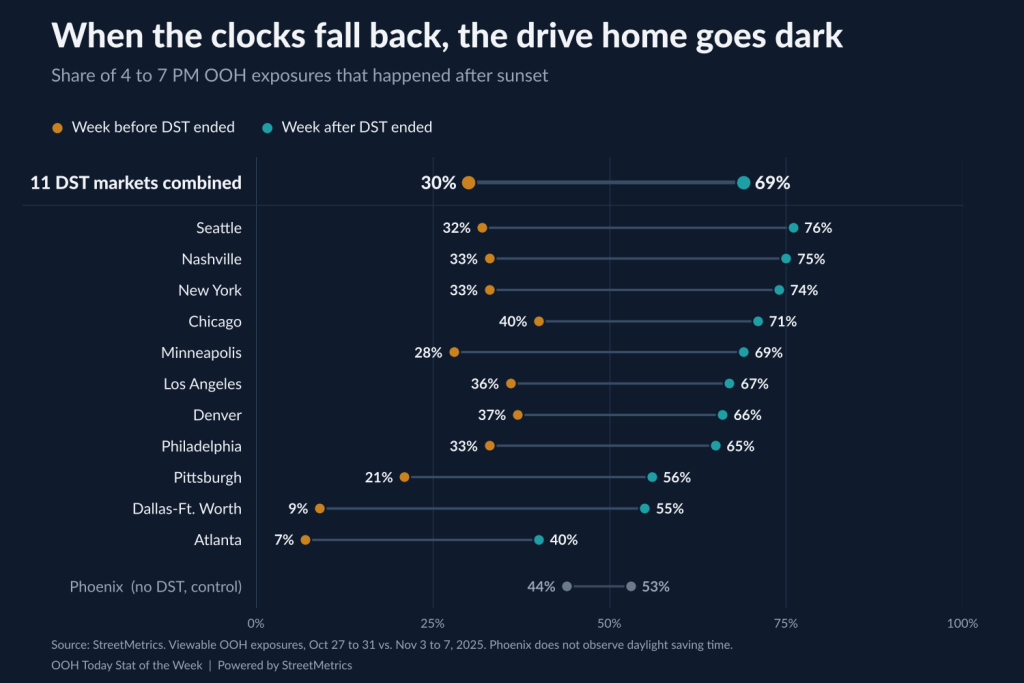
30% → 69%. That’s the share of evening-commute OOH exposures (4 to 7 PM) that happened after sunset in the week before daylight saving time ended last year, compared with the week after. We measured 11 markets that change their clocks.
The Insight
At 2 AM on Sunday, November 1, the clocks go back an hour and the sun starts setting around 5 PM. Daylight saving time started as a 1918 wartime energy-saving measure, not for farmers, who were some of its loudest critics. Work still ends at 5, so most of the drive home now happens in the dark. New York went from 33% to 74%. The biggest jumps were in cities on the western edge of their time zones. In Atlanta, the share went from 7% to 40%. In Dallas, it went from 9% to 55%.
Mornings went the other way. Before the change, 46% of 6 to 9 AM exposures happened before sunrise. After it, only 19% did.
To check that the clock change caused this, we looked at Phoenix, which doesn’t observe daylight saving time. Its evening share only moved from 44% to 53%, which is the normal shortening of days in the fall.
The Takeaway
From Sunday, November 1 until March, most evening-commute impressions happen after sunset. For evening buys, use lit faces and creative that reads at night: high contrast, short copy and large type. On digital, switch to night creative the week of the change. If your static creative needs daylight, mornings are the better bet for the winter. The change happens on one known date, so you can plan for it now.
StreetMetrics is a partner with OOH Today


- Advertisement -

