


When the Clocks Fall Back, Make Sure Your Ad Is the One That’s Lit

When the Clocks Fall Back, Make Sure Your Ad Is the One That’s Lit
by Lime Media | OOH Today
On Sunday, November 1, at 2 AM, the clocks fall back an hour, and for the out-of-home advertising industry, something more consequential happens at the same time. The evening commute goes dark.
This isn’t a metaphor. It’s a measurement story, and the numbers are striking.
What Changes on November 1
StreetMetrics recently published a Stat of the Week that every OOH buyer and planner should have in front of them right now. In the week before daylight saving time ended last year, 30% of evening-commute OOH exposures, those happening between 4 and 7 PM, occurred after sunset. In the week after, that share jumped to 69%, measured across 11 markets that observe the clock change. (oohtoday)
That’s not a gradual seasonal drift. It happens because work still ends at 5 PM, so most of the drive home now happens in the dark. The commute didn’t change. The sun did. (oohtoday)
The market-level swings are even more dramatic. In Dallas, the share of evening exposures happening after sunset went from 9% to 55%. In New York, it went from 33% to 74%. In Atlanta, from 7% to 40%. Cities on the western edge of their time zones swing the hardest, and those are often the same markets where mobile OOH density is highest. (oohtoday)
To verify that the clock change itself caused this shift rather than the natural shortening of fall days, StreetMetrics looked at Phoenix, which doesn’t observe daylight saving time. Phoenix’s evening share moved from 44% to 53% (the normal seasonal change) compared to the dramatic jumps seen everywhere else. That’s a clean control. The DST shift is the variable. The dark commute is the consequence. (oohtoday)
What This Means for Unlit Static Creative
Here’s the practical implication that most media plans don’t account for: a significant portion of your evening OOH investment is now reaching audiences in conditions your creative wasn’t designed for. Static placements without backlighting depend on ambient daylight to be readable. When that daylight disappears mid-campaign, so does a meaningful share of the impression value those placements were purchased to deliver.
This isn’t a new problem, it’s a known, predictable one. And because it happens on a single known date, it’s entirely plannable.
The morning commute tells the opposite story. Before the clock change, 46% of 6 to 9 AM exposures happened before sunrise. After the change, only 19% did. Mornings actually get better for OOH visibility after DST ends. If your static creative needs daylight, morning dayparts become your stronger play from November through March. Evening dayparts belong to lit inventory. (oohtoday)

How to Plan Creative That Reads at Night
Not all creative is built for darkness. The basics matter more than most brands give them credit for, and the window between now and November 1 is short enough that this deserves immediate attention.
For mobile digital billboard placements (where you have control), the principles are straightforward. High contrast between background and foreground is non-negotiable at night. Dark backgrounds with bright, bold copy perform significantly better than light creative that relies on daylight for legibility. Copy should be short. Type should be large. If your creative has five words, cut it to three. If it has seven elements, get to four.
Motion on LED is your biggest advantage over static. The human eye is drawn to movement in dark environments. A well-sequenced animation at night outperforms the same content displayed as a static frame in conditions where static creative loses its edge. This is where digital out-of-home earns its premium in Q4.
For campaigns running into November and beyond, consider building two creative sets: one optimized for daylight, one optimized for after dark. On digital inventory, switching to night creative the week of the clock change is a practical, low-cost move that most brands overlook entirely. (oohtoday)
How Mobile Billboard Trucks Turn the Dark Into an Advantage
This is where mobile OOH has a structural edge that fixed placements simply cannot replicate.
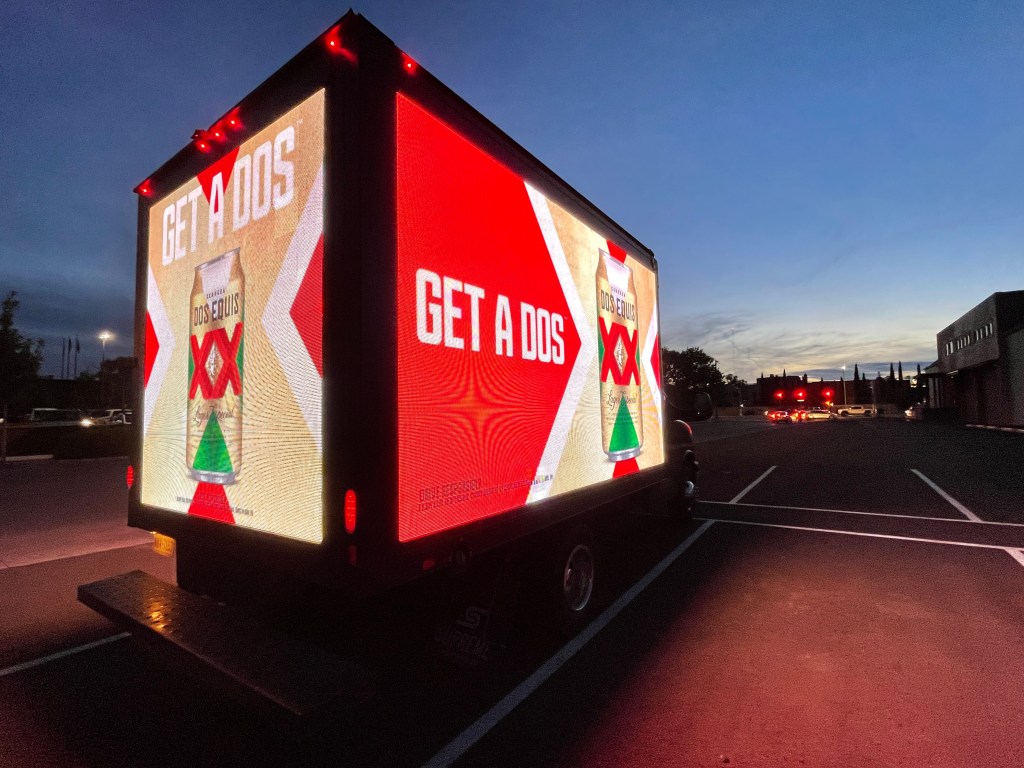
A Lime Media mobile billboard truck is self-illuminated by design. The creative runs at full brightness regardless of what the sun is doing. There’s no ambient light dependency, no readability degradation as the evening commute stretches past sunset. The truck is as visible at 6:30 PM in November as it is at 6:30 PM in June, which means the impression value you’re buying doesn’t erode when the clocks fall back.
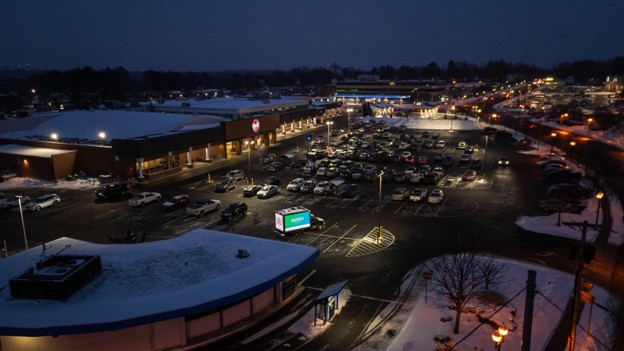
More importantly, mobile billboard trucks can be routed and dayparted to match where evening traffic actually is. The dark commute isn’t uniform across a market, it’s concentrated on specific corridors, around specific retail clusters, in the neighborhoods where your audience is moving during those 4 to 7 PM hours. GPS-traced route planning means you’re not just running a lit placement. You’re running a lit placement in the right place at the right time, with verified reporting to back it up.
For holiday-shopping evenings, which begin in earnest the moment DST ends, this combination of illumination, mobility, and precision routing is particularly valuable. Retail corridors after dark are exactly where brands want presence, and exactly where a self-illuminated truck driving targeted routes creates impact that a static unlit placement cannot.

A Q4 Checklist for OOH Buyers
The clock change happens in 12 days. Here’s what to address before it does:
- Audit your evening placements. Which inventory in your current or planned buy is unlit? What percentage of its scheduled impressions fall in the 4–7 PM window? That’s your exposure.
- Review your creative for night readability. High contrast, short copy, large type. If your current creative fails those tests, build a night version.
- Switch digital creative the week of November 1. If you’re running DOOH, update creative sets to optimize for post-sunset conditions.
- Shift underperforming evening static to morning dayparts. Mornings improve after DST ends — use that if you’re locked into static inventory.
- Build mobile billboard trucks into your Q4 evening buy. Self-illuminated, GPS-routed, daypart-optimized trucks don’t have a sunset problem. They’re built for exactly this environment.
- Plan for the full dark season. DST ends November 1. The commute stays dark until March. This isn’t a one-week adjustment, it’s a five-month media planning reality.
The Opportunity Hidden in the Data
The StreetMetrics finding is useful precisely because it’s so specific. A 30% to 69% swing in after-sunset exposures doesn’t happen gradually, it happens overnight, on one date, in markets that don’t adjust for it. That predictability is the opportunity.
The brands that plan for the dark commute will be the ones whose creative is visible when it matters most: during Q4 holiday season, in the evening hours when consumers are moving through retail environments, on the streets where purchase decisions get made on the way home. The brands that don’t will be running creative that was designed for a season that already ended.
On November 1, the clocks fall back. The drive home goes dark. The question is whether your media plan is built to stay lit.
Lime Media operates 100 owned LED billboard trucks across 50+ DMAs nationwide. To learn more about building a Q4 mobile OOH strategy, visit lime-media.com/services/led-billboard-trucks/
Lime Media is a partner with OOH Today


- Advertisement -

