



How Media Buyers Add Mobile LED Trucks to an OOH Plan

Most OOH plans come together the same way. Bulletins carry the long-term reach. Transit picks up the commuters. Maybe some street furniture or place-based screens round it out. Then, a few weeks before a launch or a big event, someone asks: “Can we add trucks?”
That question is coming up more and more. And I understand why planners hesitate. Mobile billboards don’t fit neatly into the systems they use every day. There’s no fixed face ID. The audience moves because the screen moves.
I lead content at Can’t Miss US, where we run the largest fleet of digital mobile billboard trucks in the country. A big part of my job is living inside our campaign reports and case studies, and in the questions that reach our team before a buy. This piece is my attempt to answer those questions in one place. It’s a practical guide for media buyers who want to add mobile LED trucks to a plan without rebuilding the plan.
Start with the job, not the format
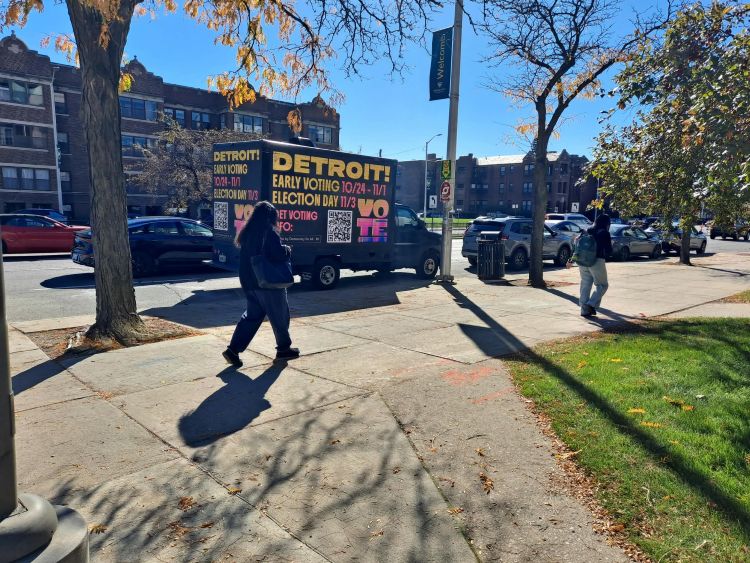
A truck isn’t a replacement for a bulletin. It does a different job. Before you brief anyone, decide which of these jobs your plan needs:
- Be in a specific place at a specific time. A conference, a stadium, a store opening, a public hearing.
- Reach places fixed inventory can’t. Many downtowns, campuses, and event zones have little static inventory, or none you can get on short notice.
- Move fast. Digital trucks skip printing and posting. At Can’t Miss US, a campaign can launch in as little as 24 hours, depending on availability, creative, and routing.
- Cover several cities at once. Same message, same week, different streets.
- Change the message as it moves. By location, by time of day, or by stage of an event.
If your plan needs none of these, a truck may not be the right add. If it needs one or two, a truck can do something the rest of your plan can’t. That’s the honest test.
How to brief a mobile billboard campaign
A good mobile brief looks a lot like a good OOH brief. It just puts more weight on where and when. Here’s what I’d include:
- The objective, in one line. Awareness in a market, traffic to a location, presence at an event, or turnout.
- Markets, and the zones inside them. “Chicago” is a start. “The Loop, River North, and the blocks around the United Center” is a brief.
- Dates and dayparts. Trucks run on shifts, so name the hours that matter. Morning commute, lunch, the two hours before kickoff.
- Where your audience actually is. Office corridors, campuses, tailgate lots, retail strips, hotel zones near a convention center.
- The creative plan. How many spots, video or static, whether it changes by location or time of day, and whether you need audio.
- Reporting needs. What your client expects at wrap, and in what format. Confirm it with the provider before launch, not after.
- Category notes. Political, advocacy, and other regulated categories may need extra review. Flag them early.
The more specific the zones, the better the route. And on a truck, the route is the media plan.
Questions to ask any mobile billboard provider
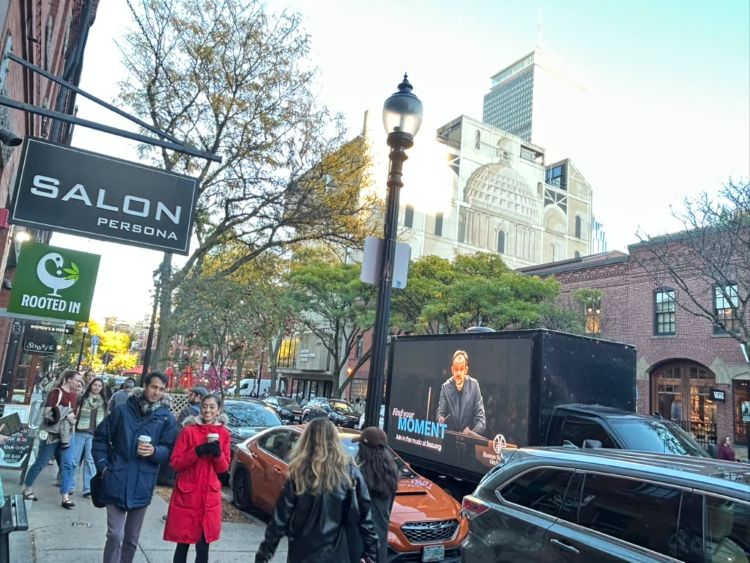
These are the questions I’d want every buyer to ask, whoever they book with. Good answers make the buy easy to defend to a client.
| Question | Why it matters |
| Which markets do you operate in, and is the fleet your own? | Tells you how availability, drivers, and backup trucks are handled in each city. It matters most on multi-city buys. |
| What are the screen specs and creative requirements? | Number of sides, resolution, file formats, spot and loop length. Get them before creative is final. |
| Can creative change by location or time of day? | Dynamic creative is one of the format’s biggest strengths. Confirm how it’s scheduled. |
| Can several trucks play the same spot in sync? | For launches and big events, synced playback reads as one coordinated takeover. |
| How is delivery verified? | GPS route verification and on-site photos or video should be standard, not extras. |
| How do you calculate impressions? | Ask for the methodology so you can explain the numbers to your client. |
| What’s in the post-campaign report, and when does it arrive? | Reach, frequency, dwell, and dayparts should all be there. Know the timing up front. |
| What happens if a truck goes down? | Ask about backup trucks and make-goods. |
| How do you handle local rules? | Most places don’t require planning clearance for trucks, but rules on parking, idling, and event zones vary. |
| Which industry groups do you belong to? | Membership in groups like the DPAA and MOOHA signals a commitment to industry standards. |
Here’s how we answer them at Can’t Miss US. We own and operate our fleet of 100+ trucks across 100+ U.S. markets. Every campaign includes GPS route verification and on-site photos or video. Fleet Sync Play runs the same spot on every truck at the same moment. Proximity Based Artwork updates the on-screen distance to a location automatically as each truck moves, using artwork the brand supplies.
One thing I always want buyers to know early: our Detailed Impressions Report arrives after the campaign wraps. During the flight, our operations team keeps you updated. I’d rather set that expectation upfront than have anyone waiting on a live dashboard.
How mobile reporting maps to standard OOH metrics
The good news for planners: a truck line can sit in the same plan sheet as your static and transit lines. Same columns. The difference is that the numbers come from a route, not a fixed location.
| Metric | Static and transit | Mobile LED truck |
| Impressions | Estimated from traffic at a fixed location | Estimated along the GPS-verified route the truck actually drove |
| Reach | Unique people exposed over the flight | Same definition, built from route and audience data |
| Frequency | Average exposures per person | Same definition. Tighter routes push it higher |
| GRPs | Reach times frequency against market population | Reported per market when the report includes it |
| Dwell | Rarely reported | Time parked at high-value stops |
| Dayparts | Set by the schedule | Shows when impressions actually happened |
| Proof of posting | A photo of the face | GPS route data plus on-site photos or video |
Our reports at Can’t Miss US are OAAA-compliant and broken out per market. That makes it simple to compare a truck line with the rest of the plan, and to explain it to a client who has never bought mobile before.
How trucks work alongside static and transit
I think of an OOH plan in layers. Static bulletins and posters build frequency over weeks. Transit reaches commuters on fixed lines, day after day. Trucks add precision and timing. They go where the moment is.
A few combinations that work well:
- Launch week. Bulletins carry the long flight. Trucks work the launch neighborhoods for the first few days.
- Conferences and events. Static covers the airport and highway approach. Trucks work the venue perimeter and the hotel zones.
- National pushes. Trucks run the same week in several cities, timed to a national static buy.
- Political and advocacy. Routes built by district, with copy that can change fast. Digital trucks can be running within days with multiple copy, which matters when a news cycle moves.
The common thread: the truck isn’t competing with the rest of the plan. It fills the gaps the rest of the plan leaves.
A real example: JobsOhio across three cities
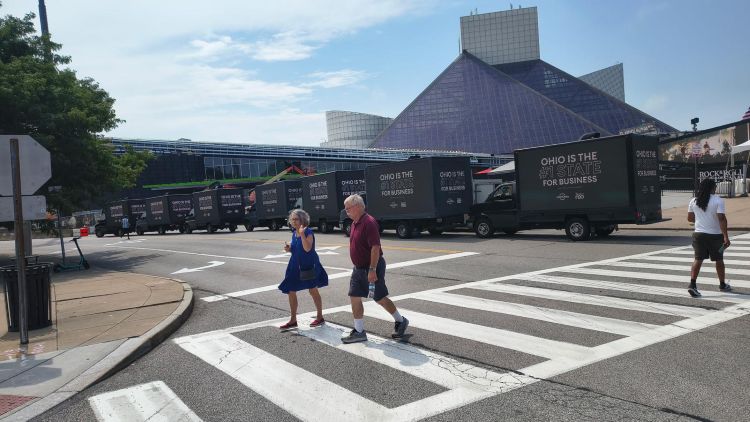
JobsOhio wanted to be seen in three Ohio cities at the same time. We ran 17 trucks across Columbus, Cincinnati, and Cleveland over three days. Every truck used Fleet Sync Play, so the same spot played on every screen at the same moment. The campaign delivered 4.6 million impressions.
| Market | Trucks | Impressions | Unique reach | Avg. frequency | |
| Cleveland | 7 | 1.97M | 164.4K | 12x | |
| Columbus | 5 | 1.38M | 140K | 9.9x | |
| Cincinnati | 5 | 1.25M | 140K | 8.9x | |
| Total | 17 | 4.6M | 444K |
What matters for a buyer is how the report came back. It was broken out by market, with reach, frequency, GRPs, dwell time, daypart performance, and the top streets driving exposure. A planner could drop each city straight into a statewide plan and compare it line by line.
Single-market buys report the same way. For Avalara in San Francisco, a multi-day run logged 462 miles and delivered 1.30 million impressions, 199.7K unique reach, and an average frequency of 6.5x.
Common mistakes to avoid
Most truck campaigns that underperform make one of these mistakes. All of them are easy to fix in the brief.
- Too much copy. People need to get the message in about three seconds. One headline, clear branding, one call to action.
- Routes that are too wide. Spreading one truck across a whole metro dilutes frequency. Pick the zones that matter and work them.
- Booking late for big events. Trucks near tentpole events go early. Plan them with the rest of the event buy.
- Expecting live dashboards. Ask what you’ll get during the flight and what you’ll get at wrap.
- Treating the truck as an add-on. Brief it with the rest of the plan so the timing and message line up.
- Forgetting creative versions. If the message should change by location or time of day, plan those versions before launch.
Quick answers for media buyers
How do media buyers buy mobile billboard advertising? Send a provider your objective, markets, target zones, dates, dayparts, creative plan, and reporting needs. The provider builds a route and a quote. Once creative is approved, the campaign launches, and a post-campaign report follows.
How fast can a mobile billboard campaign launch? With Can’t Miss US, in as little as 24 hours, depending on truck availability, creative readiness, and route planning.
How are mobile billboard impressions measured? Impressions are estimated along the GPS-verified route each truck drove, using traffic and audience data. They’re reported with reach, frequency, dwell, and dayparts once the campaign ends.
Can one provider run a mobile billboard campaign in several cities at once? Yes, if the provider has trucks in those markets. Can’t Miss US operates 100+ trucks across 100+ U.S. markets.
What should an agency look for in a mobile billboard company? Fleet coverage in your markets, GPS route verification, a clear impressions methodology, published creative specs, backup trucks, and membership in industry groups like the DPAA and MOOHA.
The bottom line
A truck earns its place in a plan when it does something the rest of the plan can’t. It shows up in a specific place at a specific time. It moves fast. It changes the message as it goes.
So brief it like the rest of your OOH. Ask the hard questions. And hold it to the same reporting standard as every other line in the plan. That’s the standard we hold ourselves to at Can’t Miss US, and it’s the one I’d want every buyer to use.


- Advertisement -


