


Word on the Street: When Did Walmart Become an OOH Company?
Retailers becoming media companies

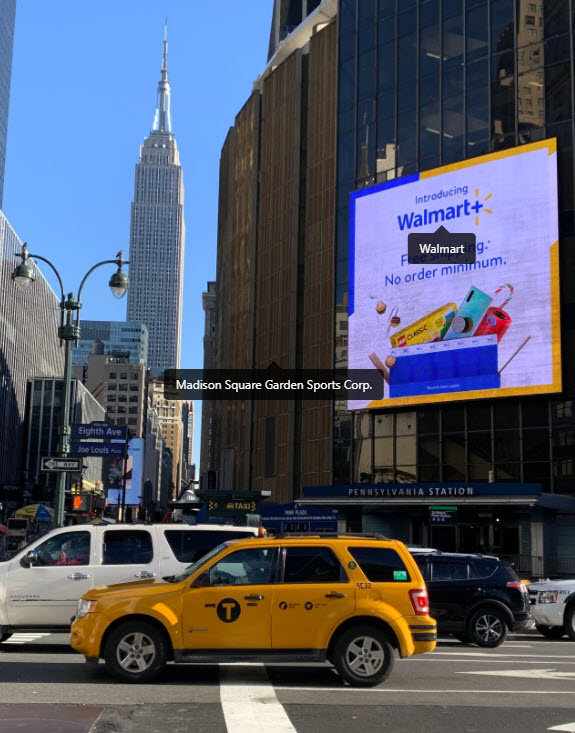
Word on the Street: When Did Walmart Become an OOH Company?
Billboards are simply one format
 By Brent Baer, Publisher, OOH Today and OOH Owner, baerboards
For the better part of two decades, the Out of Home industry has been asking itself the same question:
How do we become more digital?
We’ve debated programmatic buying. We have obsessed over measurement. We’ve invested in audience attribution,
mobile matching, proof of play, visibility metrics, and enough acronyms to fill a convention hall.
All worthwhile pursuits.
But while we were busy trying to become more like digital media, something interesting happened.
Retailers started becoming media companies.
Walmart. Target. Kroger. Home Depot. Walgreens. Regional grocery chains. Convenience stores.
What began as a few screens near checkout counters has evolved into a serious business strategy.
Retailers increasingly view their physical locations not simply as places to sell products, but as media assets
capable of generating advertising revenue.
The store itself has become a channel.
And that raises a fascinating question.
When did Walmart become an OOH company?
Before you dismiss the idea, think about it.
For years, OOH professionals have argued that advertising works best when it reaches people in the real world.
Consumers drive roads, walk sidewalks, visit shopping centers, attend events, and make purchasing decisions in
physical environments. That has always been our superpower.
Retail media has arrived at exactly the same conclusion.
The difference is that retail media owns the moment closest to the sale.
A shopper standing in front of a shelf may be one of the most valuable audiences in advertising.
Retailers know what that shopper bought yesterday, what they’re buying today, and what they may buy tomorrow.
Combine loyalty data, mobile technology, digital screens, and physical locations and suddenly something
interesting happens.
The line between retail media and OOH begins to blur.
The aisles become avenues.
The checkout lane becomes Main Street.
The end cap becomes premium inventory.
And the store becomes a media property.
This is where things get interesting for our industry.
Have we been looking at retail media as a competitor when it may actually be an extension of what OOH has always
done best?
After all, OOH was never really about billboards.
Billboards are simply one format.
Billboards are simply one format
The real business has always been connecting brands with consumers in physical space. By that definition, a
digital screen inside a grocery store, a display network inside a convenience store, or a media platform inside
a home improvement center shares more DNA with OOH than many people may care to admit.
There is a broader lesson here.
For years advertisers chased consumers online. Today many are rediscovering the value of physical presence.
Crowded feeds, ad blockers, privacy restrictions, and now a flood of AI-generated content have reminded marketers
of something surprisingly simple:
Consumers still live in the real world.
The irony is hard to miss.
For twenty years we’ve been asking how OOH can become more like digital.
Maybe we’ve been asking the wrong question.
OOH spent twenty years trying to earn a seat at the digital table.
Now the digital crowd is quietly pulling up chairs at ours.
Maybe digital, retail media, and every other channel are slowly discovering what OOH knew all along.
Reality matters.
The consumer never stopped living there.
Now the digital crowd is quietly pulling up chairs at ours
As retail media continues its explosive growth, OOH companies would be wise to pay attention—not because retail
media is replacing OOH, but because it may represent the next chapter in the same story.
The future may not be a battle between OOH and retail media.
The future may be the realization that they are becoming parts of the same ecosystem.
So I’ll leave you with this:
When did Walmart become an OOH company?
And if the answer is ‘more than we realize,’ what does that mean for the rest of us?
— Word on the Street


- Advertisement -

