



The CPM Myth: What Mobile Billboard Campaign Data Actually Reveals
When media buyers evaluate an out-of-home advertising campaign, one of the first questions they often ask is:
“What is the CPM?”
That question is understandable. CPM (cost per thousand impressions) is a standard media buying metric used across digital advertising, television, radio, and traditional out-of-home.
However, for mobile billboard advertising, CPM only represents one part of the campaign story.
Unlike many traditional media formats, digital mobile billboard campaigns provide advertisers with detailed delivery insights that go beyond a single impression number. Location data, route analysis, exposure breakdowns, campaign timing, and delivery statistics help advertisers understand how their message moved through a market.
The real value is not only knowing how many impressions were generated, but understanding where, when, and how the campaign delivered those impressions.
The Evolution of Mobile Billboard Measurement
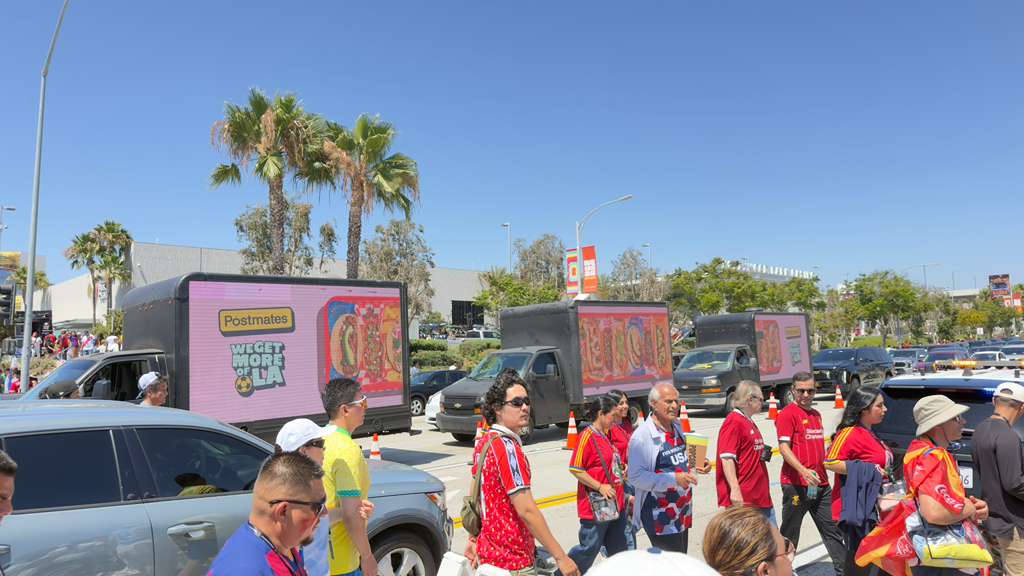
Digital mobile billboard trucks are a form of out-of-home advertising that uses LED displays mounted on vehicles to deliver dynamic advertising messages throughout targeted geographic areas.
Unlike static billboards, mobile billboard advertising allows brands to bring their message directly into specific markets, including business districts, event areas, retail corridors, neighborhoods, and high-traffic locations.
As the industry has evolved, advertisers have increasingly looked for greater transparency into campaign delivery. Today’s mobile billboard campaigns can provide detailed reporting that helps brands and agencies evaluate campaign reach, exposure opportunities, route performance, and overall delivery.
At Can’t Miss US, one of the nation’s largest owner-operated digital mobile billboard truck companies, every campaign includes detailed reporting designed to provide visibility into campaign execution and exposure delivery.
Why CPM Alone Does Not Tell the Complete Story
CPM answers an important question:
How efficiently did a campaign generate impressions?
But advertisers often need additional context:
- How many people were reached?
- How frequently were they exposed?
- Which areas generated the most exposure opportunities?
- Which streets and locations delivered the strongest visibility?
- How did campaign timing impact delivery?
A detailed mobile billboard campaign report provides this additional layer of insight.
What a Mobile Billboard Campaign Report Reveals

Reach, Impressions, and Frequency
At the foundation of every campaign is understanding overall delivery.
Campaign reporting provides key performance metrics including:
- Total impressions
- Unique reach
- Frequency
- Opportunity to see
- Total impressions delivered
These metrics help advertisers understand the scale of the campaign and how often audiences had the opportunity to view the message.
Frequency is particularly valuable because it provides context beyond total impressions. A campaign generating repeated exposure opportunities can create a different awareness impact than one focused only on reaching new audiences.
Understanding Exposure Delivery
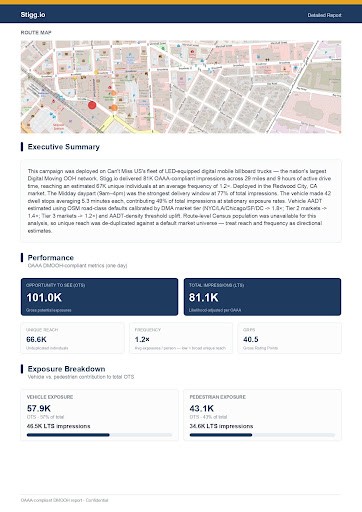
Mobile billboard campaigns generate exposure opportunities through multiple environments.
Campaign reports provide exposure breakdowns including:
- Vehicle exposure and LTS (likelihood-to-see) impressions
- Pedestrian exposure and LTS impressions
This provides advertisers with additional understanding of how impressions were distributed between people encountering the campaign through surrounding traffic and pedestrians in the campaign environment.
Geographic Insights: Where Did the Campaign Deliver?
Location is one of the defining advantages of mobile billboard advertising.
Campaign reporting provides geographic analysis through:
- Heat maps
- Exposure summaries
- Top streets by exposure
- Landmark exposure
- DMA reach penetration
These insights allow advertisers to understand where campaign visibility was strongest and how the campaign traveled throughout the market.
Rather than only receiving a total impression number, advertisers can evaluate how the campaign moved through specific areas and locations.
Flight Statistics: Understanding Campaign Movement
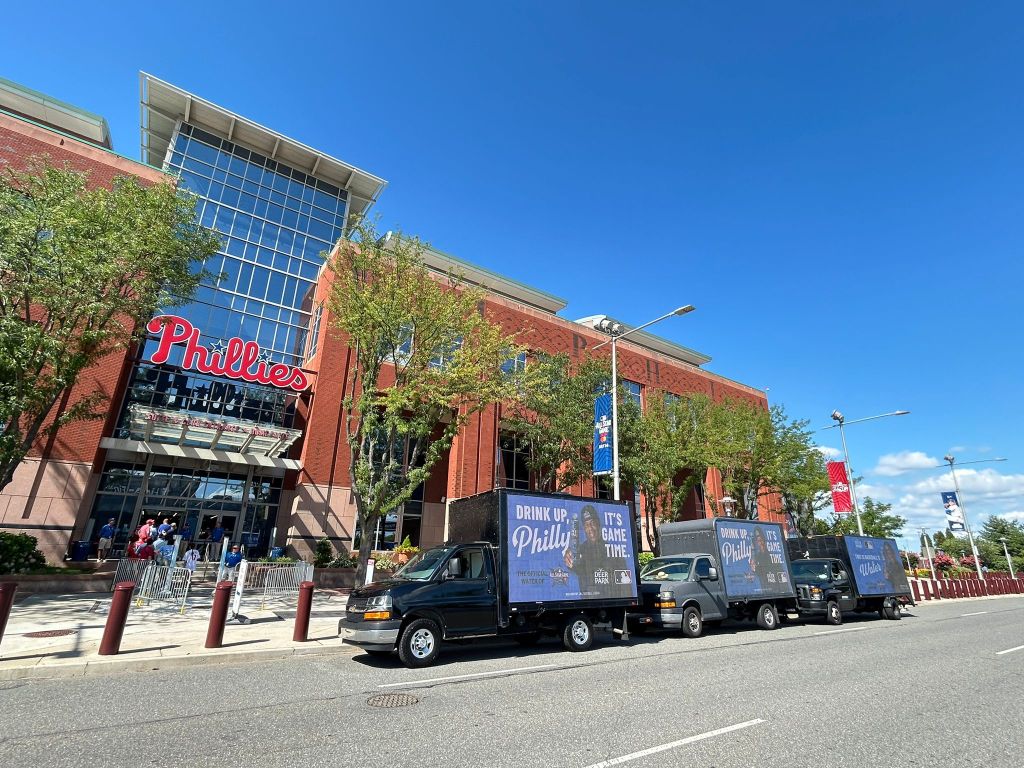
Mobile billboard advertising is unique because the media placement itself moves through the market.
Campaign reporting provides flight statistics such as:
- Total miles driven
- Number of trucks deployed
- Number of campaign days
- Active hours
- Average speed
These metrics provide transparency into campaign execution and confirm how the campaign was delivered in-market.
Stop and Dwell Analysis
In addition to movement data, campaign reports provide visibility into stopping patterns.
Stop and dwell analysis includes:
- Total stops
- Average dwell time
- Stop impression share percentage
This helps advertisers understand where the campaign spent additional time and how those locations contributed to overall exposure delivery.
Understanding When Audiences Were Most Exposed
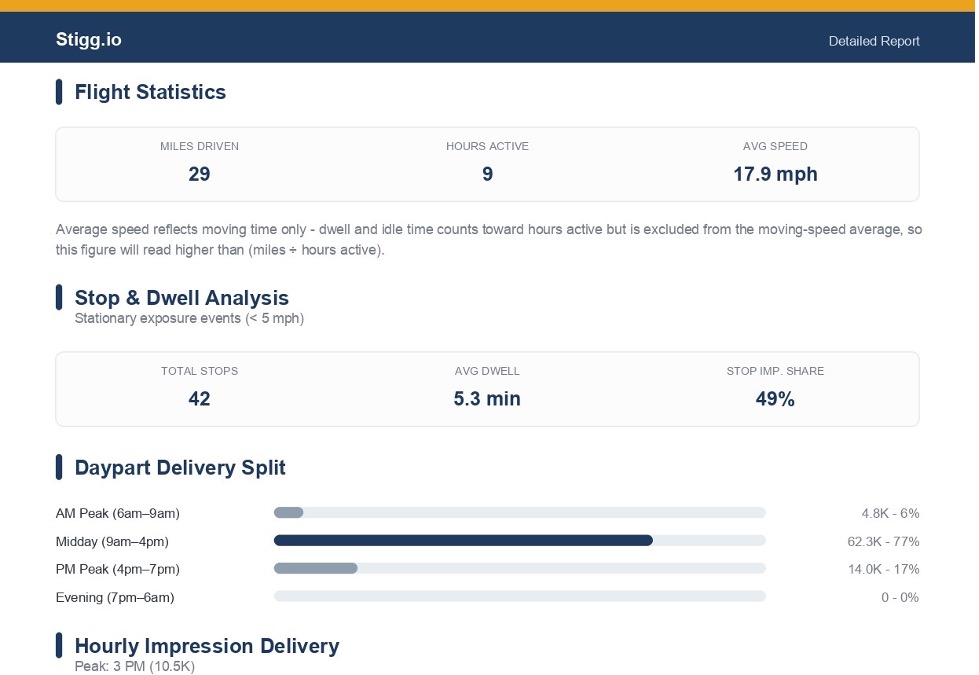
Timing plays an important role in out-of-home advertising.
Campaign reports provide:
- Daylight delivery split
- Hourly impression delivery
This allows advertisers to see which portions of the day generated the highest percentage of impressions and better understand how campaign timing affected delivery.
Drive and Screen Performance
Digital mobile billboard trucks combine vehicle movement with dynamic LED screen technology.
Campaign reporting includes drive and screen performance metrics such as:
- Drive hours
- Average screen time
- Screen utilization
- Average impressions per hour
These insights provide visibility into how efficiently screen activity translated into campaign exposure opportunities.
Screen Visibility Analysis

For multi-sided digital mobile billboard trucks, screen position can impact visibility.
Campaign reports include impressions by screen side, allowing advertisers to understand how exposure was distributed across different display surfaces.
Market Context and Statistical Confidence
Reliable reporting requires understanding the quality and context behind campaign estimates.
Campaign reports include statistical confidence measurements and market context to provide additional perspective on impression estimates and reporting accuracy.
Additional campaign context may include:
- Weather conditions
- Traffic data sources
- Market characteristics
These details help advertisers better understand the environment in which the campaign was delivered.
Comparing Mobile and Static Out-of-Home Advantages
Mobile billboard campaigns offer capabilities that differ from traditional static placements.
Campaign reporting can highlight comparisons such as:
- Reach advantage
- Unique reach
- Timing index
This provides advertisers with additional context when evaluating mobile versus static out-of-home strategies.
Turning Campaign Reporting Into Better Decisions
The purpose of campaign reporting is not simply to provide numbers after a campaign ends.
The purpose is to create better-informed decisions for future planning.
Advertisers can use campaign insights to evaluate:
- Which markets generated the strongest delivery
- Which streets and locations created the most exposure opportunities
- How timing affected impressions
- How many trucks and campaign days were appropriate for future initiatives
For brands running campaigns across multiple markets, this level of reporting creates consistency and transparency.
The Future of Mobile Billboard Advertising Is Measurement
Mobile billboard advertising has always offered a unique advantage: the ability to bring a brand message directly into targeted environments.
Today, the industry is becoming increasingly data-driven.
As advertisers continue to demand greater transparency from their media partners, detailed campaign reporting will play an increasingly important role in evaluating out-of-home investments.
The question is no longer only:
“How many impressions did we generate?”
The better question is:
“Where did those impressions happen, how were they delivered, and what did we learn from the campaign?”
That shift—from simply measuring exposure to understanding campaign delivery—is shaping the future of mobile billboard advertising.



- Advertisement -


