



Physical Scale. Digital Proof. How Mobile OOH Is Finally Closing the Full-Funnel Loop


Physical Scale. Digital Proof. How Mobile OOH Is Finally Closing the Full-Funnel Loop
by Lime Media
Out-of-home advertising just crossed $3 billion in quarterly revenue for the first time, and the brands driving that growth aren’t just buying OOH for visibility. They’re buying it because the measurement infrastructure has finally caught up to the medium’s actual impact.
That shift didn’t happen overnight. For years, out-of-home advertising occupied a specific and somewhat limited role in the modern media mix. Its ability to build brand awareness at scale was well-documented and widely accepted. Its capacity to put a brand physically in front of a market- in the corridors where consumers actually live, work, and move- was undisputed. And yet, when performance budget conversations happened, OOH consistently struggled to compete with channels that offered cleaner, faster attribution stories. The result was predictable: OOH earned brand dollars but rarely performance dollars, because the industry couldn’t close the loop between a truck on a street and a transaction at the register.
That dynamic is changing, not because OOH has gotten louder about its value, but because the measurement tools have finally matured to match the medium’s ambition. And a recent campaign with the San Jose Earthquakes is one of the clearest illustrations yet of what full-funnel mobile OOH measurement looks like when it’s done right.
The Campaign: One Truck, Two Days, One Market
The San Jose Earthquakes came to Lime Media with a question that every sports marketer has asked at some point: can we actually connect OOH exposure to ticket sales? Not impressions. Not estimated reach. Actual, verified, traceable ticket purchases.
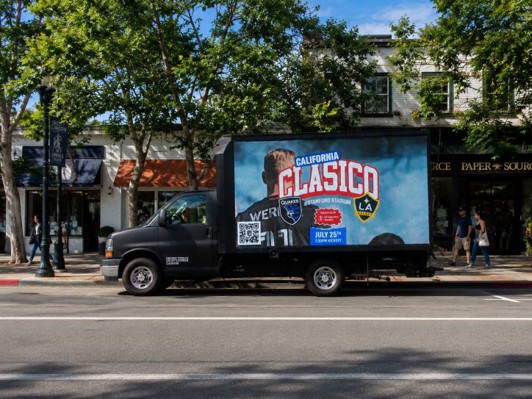
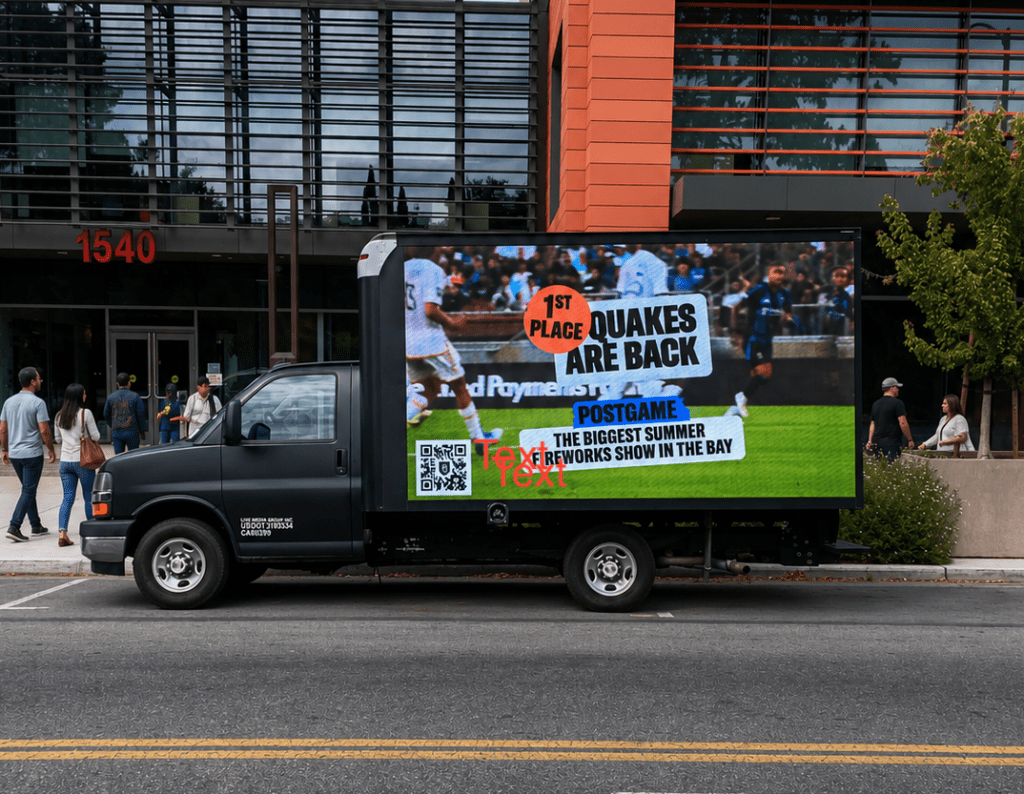
The answer required two things working in concert. The first was physical scale: a single LED billboard truck running GPS-traced routes through the San Jose market, putting the Earthquakes brand in front of the right audience at street level with 100% share of voice. The second was a digital layer: shadowfencing technology that reinforced the exact same routes the truck drove, serving clickable mobile ads to devices in proximity to the truck in real time, paired with pixel tracking that captured every engagement driven back to the campaign.
Two channels. One coordinated strategy. The truck built exposure at a scale digital alone can’t buy. The digital layer built a measurable path back to purchase. Paired together, they moved one market through the full funnel: awareness, engagement, and conversion in a single flight.
The Funnel, By the Numbers
Over the course of two activation days, the results told a story that reframes how mobile OOH should be evaluated.
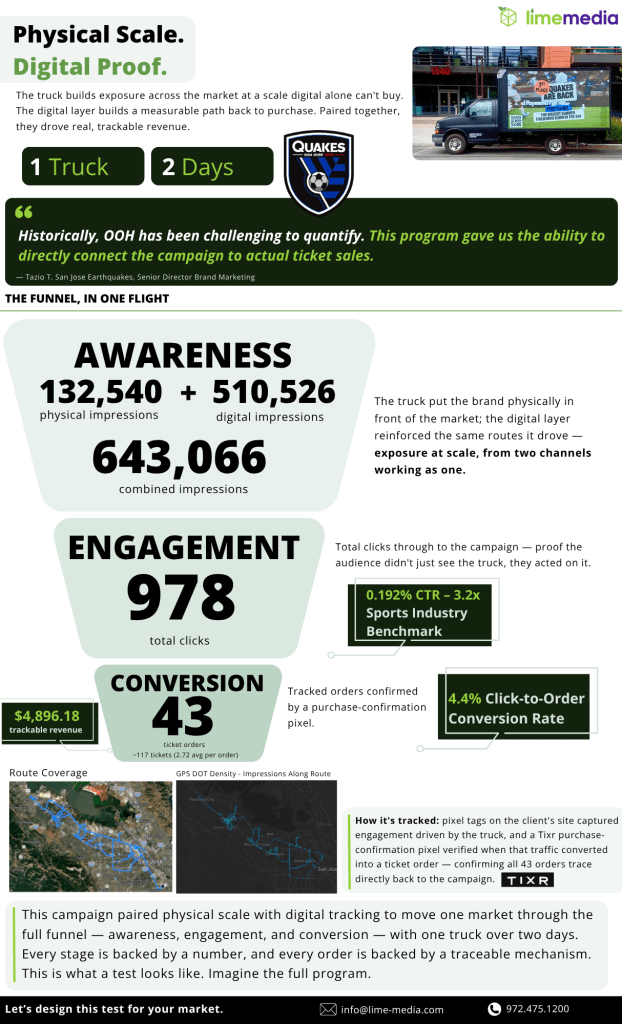
At the awareness level, the truck’s GPS-traced routes generated 132,540 physical impressions, amplified by 510,526 digital impressions from the shadowfencing layer: 643,066 combined impressions at a blended CPM of $7.78. Broad market coverage at a cost efficiency that most digital-only campaigns struggle to match.
At the engagement level, the campaign generated 978 total clicks through to the Earthquakes’ campaign: a 0.192% CTR that ran 3.2x above the sports industry benchmark. The audience didn’t just see the truck. They acted on it.
At the conversion level, 43 tracked ticket orders were confirmed by a Tixr purchase-confirmation pixel: approximately 117 tickets at an average of 2.72 per order, generating $4,896.18 in directly trackable revenue. Every single order traces back to the campaign through a verified, pixel-confirmed mechanism. Not modeled. Not estimated. Confirmed.
How the Tracking Actually Works
The credibility of full-funnel OOH measurement depends entirely on the rigor of the attribution methodology: and this is where the technical picture matters.
Pixel tags embedded on the Earthquakes’ site captured engagement driven by the truck’s routes, connecting digital behavior back to physical exposure. A Tixr purchase-confirmation pixel then verified when that traffic converted into an actual ticket order, creating an unbroken chain of attribution from truck impression to completed purchase. Every one of the 43 orders is confirmed by that mechanism.
This isn’t correlation. It’s causation: verified, traceable, and backed by a purchase-confirmation pixel that removes any ambiguity about where the revenue came from. It’s the kind of attribution story that has historically belonged exclusively to digital channels. Mobile OOH can now tell it too.
The Infrastructure Behind the Attribution
Results like these don’t happen by accident, they happen because of the platform built to deliver them. Lime Media’s network of 100 owned and operated LED billboard trucks across 50+ DMAs gives brands the physical infrastructure to reach markets at scale, with 100% share of voice and GPS-verified route reporting on every campaign. But the physical truck is only half the equation. Lime Media’s data and campaign intelligence layer, built on audience segmentation, behavioral routing, and real-time optimization, ensures the truck is running where it will have the highest impact before a single impression is served. And through measurement partnerships with industry-leading technology providers, every campaign can be connected to the full suite of downstream outcomes that matter: foot traffic lift, web traffic correlation, device ID passback for digital retargeting, and where appropriate, pixel-confirmed purchase attribution of the kind that made the San Jose Earthquakes campaign possible. The physical scale is Lime Media’s. The digital proof follows from it.
The Client Perspective
Tazio T., Senior Director of Brand Marketing at the San Jose Earthquakes, reflected on what made this campaign different from previous OOH experiences:
“Historically, OOH has been challenging to quantify. This program gave us the ability to directly connect the campaign to actual ticket sales.”
That statement captures something important about where the industry is heading. The expectation of accountability is no longer unique to digital. It’s spreading across every line item in the media plan. And the OOH programs that can meet that expectation, with verified, full-funnel attribution that connects exposure to engagement to revenue, are the ones earning larger shares of performance budgets going forward.
What This Means for the Broader Industry
The OAAA’s Q2 2026 revenue report that was recently published tells a compelling macro story: OOH revenue surged 10.7% to $3.16 billion, marking the first time quarterly OOH revenue has surpassed $3 billion, with nearly three-quarters of the top 100 OOH advertisers increasing their spending year over year. The medium is clearly experiencing a significant moment of institutional confidence.
But the more interesting story isn’t the revenue growth. It’s why the growth is happening. The brands increasing OOH investment aren’t doing so on faith, they’re doing so because the tools to plan smarter campaigns, activate with more precision, and measure outcomes with genuine rigor are now available in ways they weren’t even two or three years ago.
The San Jose Earthquakes campaign is a small but precise illustration of that shift. One truck. Two days. A full funnel of awareness, engagement, conversion, backed by verified numbers at every stage. This is what a test looks like. Imagine the full program.
The Question Was Never Whether OOH Works
The data has long suggested that out-of-home advertising delivers real impact. What the industry has lacked (until recently) is the infrastructure to prove it in terms that performance budgets respond to. GPS-traced routes. Pixel-confirmed attribution. Purchase-verified conversion data. These aren’t aspirational capabilities. They’re operational realities, available today, on campaigns that start with a single truck in a single market.
The gap between what OOH delivers and what it can prove has officially closed. The only question now is which brands will move first to take advantage of it.
To learn more about Lime Media’s LED billboard truck program and full-funnel measurement capabilities, visit lime-media.com/services/led-billboard-trucks/ and for the full case study, visit https://lime-media.com/work/san-jose-earthquakes/
About Lime Media
Founded in 2005, Lime Media is a leading mobile experiential marketing company delivering turnkey, high-impact brand campaigns nationwide. With the industry’s largest experiential fleet- 250+ assets, including 80+ owned and operated LED billboard trucks- Lime offers unmatched scale, mobility, and visibility.
Backed by real-time data, verified measurement, and in-house production and logistics expertise, Lime transforms street-level engagement into accountable, results-driven performance for the world’s leading brands and agencies. https://lime-media.com/


- Advertisement -

