


How to Make Sustainable OOH Profitable? Try California.
Electric Bus Transit Media is Finding Success in Cali Commuter Buses

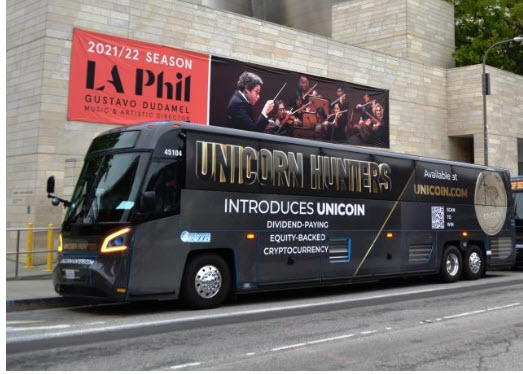
Try California Electric Buses
 By Amber Larkins, OOH Today
California tends to be more progressive in matters of climate change than many other parts of the US. There is legislature coming soon that compels companies to report their emissions. But is it true all over the country? We live in a capitalistic society, and the future of sustainability likely relies heavily on the ability to make money on it.


Something Ely Sorkin, Founder and CEO at Electric Bus Transit Media is doing in the Los Angeles market. Electric Bus Transit Media, a small mom-and-pop media company has an exclusive media contract with the Antelope Valley Transit Authority(AVTA), who changed all their buses from diesel to electric two years ago.
Sorkin says the change to electric is one of his key selling points.
“The conversation has shifted,” Sorkin said. “Consumers demand sustainability from their products and the brands that make them.
Sorkin says that even though his clients want sustainability, this is often at the C-suite level. He said oftentimes, regular buyers and planners are more concerned with filling their sales spreadsheet and are less likely to prioritize a lower carbon footprint. (We at OOH Today would argue that even at C-suite levels, many companies do green-washing or pay lip service to the cause of protecting the planet.)
“My goal is to add value to all of these folks, but we are for-profit-business so it becomes a win-win,” Sorkin said. “We make money while addressing the climate issue.”
Electric Bus Transit Media deals almost exclusively in full wraps, which are far more effective than separating ads into Kings, Queens, and Tails. Electronic Media’s bus wraps provide 45ft of moving exposure to the high-end demographics within some of the most upscale neighborhoods in Los Angeles, making it popular with luxury brands including, clothing brands, luggage brands, and consumer brands, all with the added bonus of zero emissions.
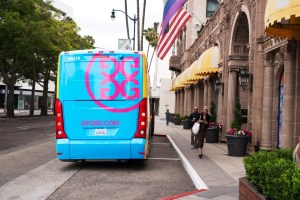
Zero emissions mean advertisements stay cleaner. When you think of a diesel tails advertisement, not only can it be obscured by the exhaust coming from the tailpipe, but the ad itself can get dirty from the car’s waste. This can cause less positive brand perceptions. Electric provides you with an absolutely clean image.
Sorkin’s 18 commuter buses run on three main commuter routes in Los Angeles. The first is the “Premium” route. It encompasses West Hollywood, Beverly Hills, Century City, and Westwood. The second is the Downtown LA route, and the third is the San Fernando Valley route.
These commuter buses do not run on a continuous loop like hop-on and hop-off buses, but they do provide a surprising amount of exposure. They have been rated by Geopath for 417,000 individual (7,506,000 altogether) 18+ impressions per four-week campaign. The commutes run about three hours in the morning and three hours in the evening during rush hour.
The diesel competition is steep, but Sorkin says the sustainability aspect of his business helps him sell.
“We’re the little guy. We’re trying to go up against the Double Decker Tourbuses where people can hop on and hop off, the Metro fleet, and the Santa Monica blue bus,” Sorkin said. “The sustainability aspect puts us more on the map,” Sorkin said.
What he’s learned as a member of Ad Net Zero is that there’s a push toward sustainability, but it’s more prevalent in the digital world than in OOH.
“In OOH, there’s not much you can do to reduce the carbon footprint,” Sorkin said.
For digital billboards, they can tweak lighting and infrastructure. Some static billboards are painted with a coating that pulls CO2 from the air.
“There’s not much else you can do to make it more sustainable, which is where we sort of shine because it’s like having a Tesla for a billboard,” Sorkin said. “We are truly electric with zero emissions. The media does reduce emissions and pollution.”
But – aren’t the wraps still vinyl?
Sorkin says they use non-PVC vinyl that has 3M’s Greenguard Gold certification, which is the most sustainable on the market, and then take it to a recycling center.
“Vinyl is still vinyl. We try not to just throw it in the trash, and we try to practice responsible recycling,” Sorkin said.
Sorkin is working on a test case study to share at the OAAA convention this April. He wants to quantify the actual pounds of carbon saved by running a campaign on electricity rather than on diesel.
“I like the electric world. What I see is there’s a big move towards electrification for bus fleets. Electric buses are the future, Sorkin said. “If you can decrease the amount of carbon in the air and be a successful advertiser, then I like that strategy.”


- Advertisement -

