



Have Digital Displays Become Commodities?
Does brand of display matter or are they all the same?


Have Digital Displays Become Commodities?

By Amber Larkins, OOH Today
Have digital displays become a commodity? Is this a good or a bad thing? Who is it good for? To really dive into this first let’s consider the definition of commodity from the Cambridge English Dictionary:
“a product that is the same as other products of the same type from other producers or manufacturers”
Sugar is a good example of this. No one says, “I’m going to buy some Domino sugar.” Sugar is sugar. No single brand of sugar will dominate the market. The opposite of this would be “Coke.” Coke is such a strong brand that depending where you live, it is ubiquitous with soda.
Are Digital Advertising Displays like Sugar or does Brand Matter?
 Joni Schmeichel of Daktronics says she’s seen the desire for quality vs. screens as a commodity go in cycles. Sometimes, quality matters, and sometimes, media owners just want to buy a screen—hopefully at not too big of an expense.
Daktronics has long been known as the safe choice. It may be more expensive than some alternatives, but the product is reliable and looks good. If compared to car brands, it would be a Lexus vs. a Toyota or Scion(back in the day).
“For years, we had just one product, and then we realized not every OOH is the same,” Joni said. “Some want the ROI upfront because they may want to sell their unit or whatever it might be. Not everyone needs a Lexus.”
Now, Daktronics offers multiple OOH products, like it does for its other business lines. This helps it be more competitive in the market.
“There are customers who have bought our higher-end product for years, and they appreciate that it’s going to look good for 10+ years and they don’t have to worry about it. Others don’t realize that until they are 7 years into a product, then now, oh, maybe it doesn’t look as good as it did on year one,” Schmeichel said.
When does a digital advertising display need to be replaced?
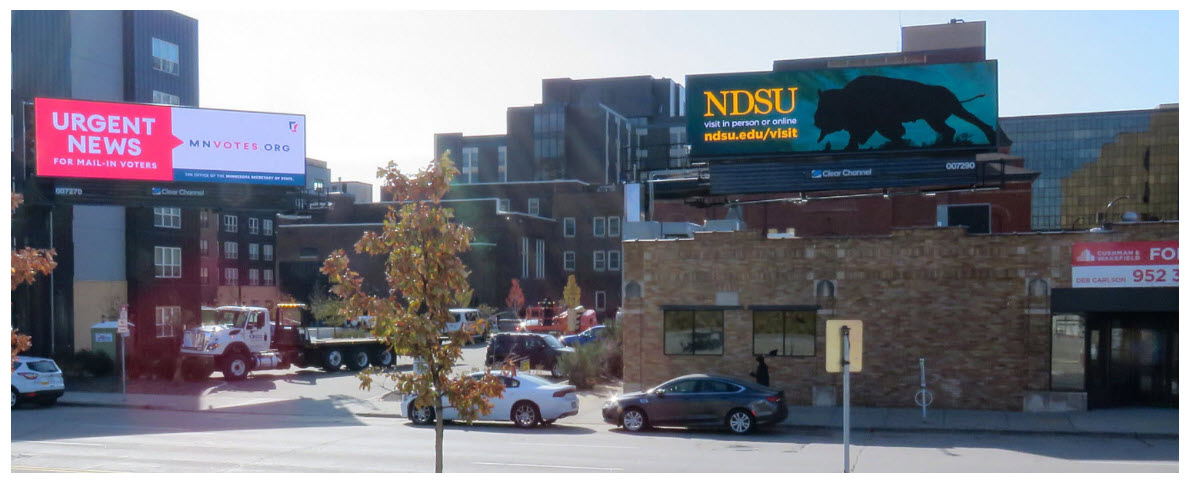
When Billboard displays age they can have a number of different problems, including:
- Colors fading or bleeding so that they cannot truly represent a brand’s colors
- Quilt work pattern where you can see all of the little modules or bricks in a display
- A portion of the display being out so that it cuts off a website address or a portion of a message.
- replacement parts are no longer available
What Happens if you Don’t Maintain Your Digital Display?
Advertisers whose displays need maintenance or replacement can lose money. They could have less advertising revenue or their display may not even be active. The billboard will lose value. This can mean less advertising revenue or your display is inactive. The billboard will not be worth what it used to be. To avoid losing revenue, electronic billboards must perform the same way from the day they are bought until the day they are replaced.
Many operators want their ROI immediately and are not thinking about the long term. They may buy the cheaper display because they all look the same.
Schmeichel said first-time buyers often go for what looks good and don’t think about down the line to years 5, 6, 7, or 8. Daktronics products are designed to be good for 10 years. They support parts for that product for 12 years after the last manufacture date of that product line. Business owners should know that after 12 years, they can’t buy parts anymore.
“We can’t provide the parts and run the risk of not having the parts to replace it if something fails ,” she said
At Daktronics, the actual displays are built a little bit differently than some of their competitors. Many of their competitors offer 10-year warranties/ replacement parts. How they are manufactured is also different. Daktronics manufactures from the LED component up.
All components are manufactured and built from the ground up in South Dakota. Many other manufacturers will have portions of the display built—such as the panel—and then have them assembled. Daktronics builds its displays brick by brick, whereas some of its cheaper competitors build them like boxed houses from Sears. There’s no issue with the boxed version pieced together except for the potential for wear and tear in the shipping process and the potential for air to get into the display.
Schmeichel says Daktronics has in-house processes and calibration methods to ensure image quality and lasting displays, including a reliability lab where they break and test displays to the max.
“Over the years we have learned that these are the things that generate more revenue for our customers in the long run,” Joni said. “Overall cost of a display is going to be less from Daktronics as far as service and image quality, but it’s hard.”
Additional Challenges for Digital Displays
“It swings back and forth in cycles and we’re in the years right now of price wins, but we’re not really thinking about the advertiser and the end game,” Joni said. “If you think back to print ads you would always get a proof back showing what the ad looks like. You wouldn’t let it go through to print if it were grainy and not the highest resolution.”
She laments that there’s no similar check or balance for that in the digital billboard industry.
“Unless you are driving by, there’s no POP. You can get a webcam proof, but they are crap,” Joni said. “You can know your ad is playing, but it’s not a true representation of what it looks like for the passerby.”
In this case, it’s not about being a commodity but about image quality. But why is there no POP? In smaller markets and buys, advertisers can drive by and see that the display doesn’t look good. But in big cities, big companies, and national buys, you can’t check every display.
If a static display had these issues, then as an advertiser, why would you buy from them? (You wouldn’t).
However, many media owners look at Billboards as a commodity. They may think, “It doesn’t matter which one I buy, the amount of revenue is going to be the same. I ‘m not going to make more money so why does it matter?”
It is not a matter of making more money. Down the line, it becomes a matter of making less money and losing business to your competitors because the ad space doesn’t look as good.
“It’s hard to make the decision to replace when you are getting money and you are not going to get more from getting a new display,” Schmeichel said. “You’re probably not going to get more from putting up a new display. But you could lose advertisers if it looks like crap.”
Schmeichel wants media owners to be more active about maintaining their boards and to start thinking about replacements around year 7 instead of when they are completely failing and don’t have a replacement part. Thinking ahead saves time and money. But she says many wait until it fails and replacement support is no longer available.
Daktronics is an advertiser with OOH Today


- Advertisement -


This isn’t reporting. It’s an advertisement for Daktronics.