



AI Ads Everywhere, Creative Scarcity![]()

by Adam Singer, VP Marketing at AdQuick
There’s a quiet inversion happening in marketing right now. For a decade, the gravitational center of creativity lived inside the feed: optimized, iterated, A/B tested into submission. The goal was simply marginal gains. Slightly higher CTR, slightly longer watch time, creativity became probabilistic. AI didn’t start this trend, but it has accelerated it to the point of absurdity. When everything can be generated, everything starts to feel the same.
Scroll any platform and you’ll see it: competent, polished, utterly forgettable content. Infinite variations of “good enough.” The marginal cost of this work, so many in our industry do, has collapsed, but along with it, so has its impact. We’re entering a phase where the scarcest resource is no longer production capacity; it’s attention that actually means something.
And so marketers are reacting. Smart pros are leading us back to how creative used to be. There’s a growing realization that bold, in-your-face creativity doesn’t belong in the feed anymore. The feed compresses everything into the same plane: a thumb-driven blur where a brand moment has milliseconds to exist before being replaced. Even great work gets flattened by the environment.
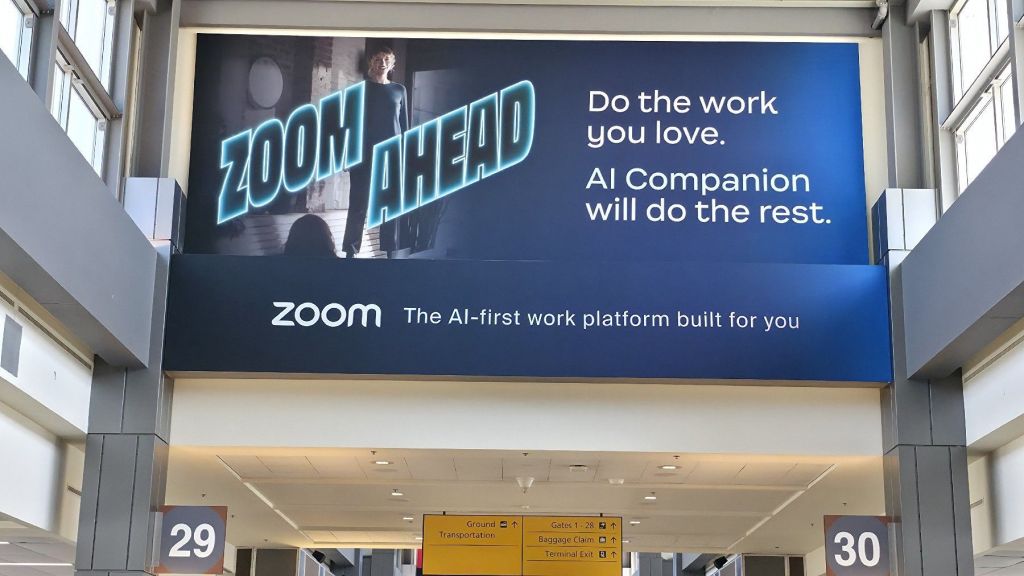
Out-of-home flips that dynamic. A well-placed billboard or installation isn’t competing with a thousand adjacent posts and notifications. It exists in physical space, at human scale, where context can’t be scrolled away. You can’t mute it, block it, or algorithmically filter it out. That constraint is precisely what makes it powerful. In a world flooded with synthetic content, the physical starts to feel like proof of work and that someone, somewhere, actually cared.
Out-of-home flips that dynamic
This is why the recent wave of “anti-AI sentiment” is less about the technology itself and more about what it represents: a saturation of generic output. People aren’t rejecting AI; they’re rejecting sameness. They’re craving signals that something was made with intent, taste, and a point of view. Brands are picking up on this.
We’re seeing a return to creative that feels deliberate, even confrontational. Work that doesn’t try to please everyone in a feed, but instead makes a clear, singular statement in the real world. The kind of work that gets photographed, shared, and talked about. Not because it was optimized in a lab for engagement using statistical modeling, but because it earned it by being bold and taking a chance.
Out-of-home is becoming center stage for this shift
Out-of-home is becoming center stage for this shift. A place where creativity isn’t diluted by adjacency to low-quality content, misinformation, and endless webspam. A controlled, premium environment where the message stands on its own. In that sense, the resurgence of OOH is a corrective trend towards an ads-landscape that’s not “enshittified.”
When everything is easy to make, the hardest thing becomes making something that actually connects and stands out. And increasingly, that happens away from your smartphone.


- Advertisement -

