



Rethinking OOH Exposure: Keep It Simple
By Drew Jackson, CEO of StreetMetrics
OTS Sounds Like “On-the-Shelf.” And that’s exactly what a CPG brand thought it meant when one of our partners used the term in a meeting.
They weren’t questioning the accuracy of the numbers—they were questioning the language describing the numbers. That moment hit me hard. Because over the past few months, I’ve heard multiple versions of the same thing:
“Drew, our advertisers don’t know what an OTS or LTS impression is. I spend more time explaining them than selling the campaign. It’s creating friction. Can’t we just say what these numbers actually mean?”
This isn’t about whether OTS or LTS were wrong to begin with. These terms were created in a different era, for a different purpose—and they served us well when OOH was a more contained, specialist-driven business.
But with the advent of programmatic buying and data-driven measurement, that’s not the business we’re in anymore.
If We Want OOH to Grow, We Have to Speak the Same Language
OOH is evolving faster than ever: more formats, better targeting, deeper reporting, stronger attribution. The opportunity has never been greater.
But if we want a bigger slice of digital budgets, we can’t expect buyers to learn our language first. We have to meet them in theirs.
Today’s planners and CMOs live in a world of “viewable” and “attributable” impressions. When we show up with terms like OTS and LTS, we introduce confusion—and make ourselves harder to compare to the channels we’re competing against.
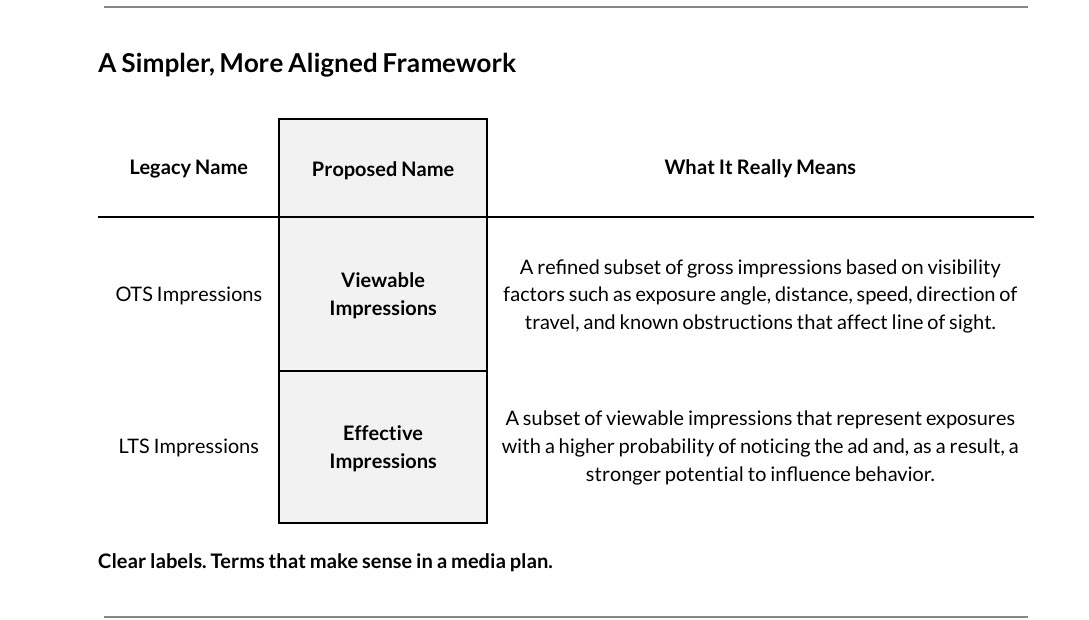
That’s why, at StreetMetrics, we’re advocating for a simpler, aligned model. Not to erase the history behind these terms, but to translate it for the buyers we need to win over.
The Problem With Legacy Terms
Let’s be honest: these labels don’t help us in the sales room anymore.
● OTS (Opportunity-to-See): Originally designed to estimate everyone who could have seen an ad based on traffic, location data, and visibility factors. It’s useful for understanding potential exposure, but the word “opportunity” can feel imprecise to buyers used to metrics that confirm actual viewability. In other channels, “opportunity” often implies possibility rather than certainty, which can make OTS harder to translate without extra explanation.
● LTS (Likelihood-to-See): An evolution of OTS, incorporating additional factors like dwell time, readability, and environmental conditions. It aims to narrow potential exposure down to a more realistic number. Still, “likelihood” relies on modeled assumptions that aren’t transparent to the buyer (and sellers if we’re honest with ourselves) making it challenging to explain at scale and even harder to compare directly with digital metrics.
These were built by and for OOH specialists—not for the modern marketers comparing CTV, social, and display, and OOH in the same plan. That’s the gap we have to close.
![]() Let’s Stop Making This Harder Than It Has to Be
Let’s Stop Making This Harder Than It Has to Be
 Let’s Stop Making This Harder Than It Has to Be
OOH has a shot at unprecedented growth… if buyers can quickly grasp what we’re selling. Every acronym we invent is one more barrier between us and their budgets.
Other initiatives to simplify placement and format naming are already underway. Measurement should be next. Not because change is easy, but because it’s necessary.
At StreetMetrics, our mission is to modernize OOH measurement for the omnichannel future. That means preserving what makes OOH so unique.
If OOH can become understandable, it becomes more comparable.
If it becomes comparable, it becomes more investable.
And if it becomes more investable, we unlock the industry’s next stage of growth.
The platform we launched earlier this month (StreetMetrics Intelligence) embeds these impression tiers as a default not because they sound better, but because they work better. They align with how media agencies and brands already think. And they’re one way we can move the industry forward… together.


- Advertisement -


Unfortunately while “keeping it simple” is to be admired, most of this piece is flawed and therfore would add to the existing confusions in OOH measurement and metrics and media overall. These confusions have been exacerbated by the two recent OOH Standards [sic] released by MRC which were generally castigated by the international OOH JICs as they ignored the Global Guidelines for OOH established by the World Out-of-Home Organisation, May 2022. These MRC documents continued to change and consequently misinterpret established media terms to seemingly benefit the technopolies and digital social media in collusion with iab. “Viewable Impressions”, aka “content rendered counts”, reflect no REAL OTS per ROUTE UK and are merely distribution/circulation numbers with NO persons-based content exposure measurement (like TVision, Lumens, or GeoPath.)
To protect the relative value of OOH versus other media, insist that GeoPath returns to the eloquent simple description of its “visibility adjusted contacts” ,VAC, measurement – “Eyes-On” which was abandoned courtesy of OAAA!!
Eyes-On metrics are the prerequisite measure for attention. No attention, there can be no outcomes. So if you are not including GeoPath for OOH planning, buying or selling you will not understand the real value of the medium.
“Eyes-On metrics are the prerequisite measure for attention. No attention, there can be no outcomes. So if you are not including GeoPath for OOH planning, buying or selling you will not understand the real value of the medium.”
We believe you nailed the real rethinking, Tony Jarvis.