


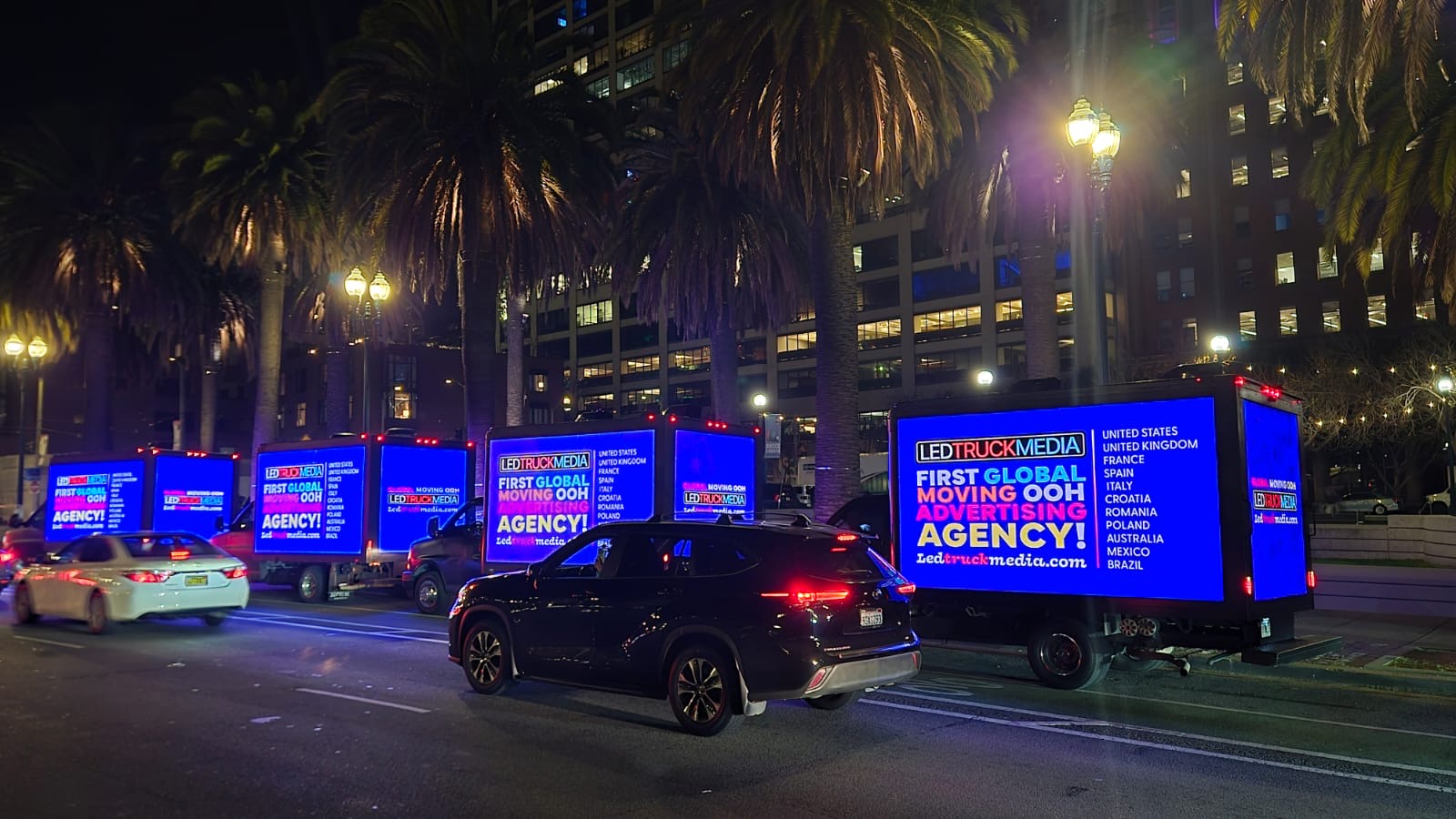
Mobile Digital Billboard Trucks at Mega-Events: When “Moveable Media” Becomes the Smartest Buy on the Street
Mobile digital billboard trucks (LED trucks, “digital billboards on wheels”) get dismissed as a gimmick until you plan a major-event week and realize the truth: the most valuable audience is rarely inside the venue. It’s in the miles of arrivals, fan zones, sponsor activations, after-parties, hotels, restaurants, and choke points that form around the event like a weather system.
For the Super Bowl, FIFA, Formula One, and the Oscars, mobile digital trucks can be an unusually effective tool—if you treat them like tactical OOH, not a novelty parade.
What makes them effective at major events
1) They hunt the crowd instead of waiting for the crowd.
Static OOH is king for scale, but it’s locked in place. Mobile trucks let you “shadow” the audience: stadium perimeters, fan festivals, sponsor villages, credential entrances, premium hotel corridors, airport routes, and nightlife districts.
2) They solve the “perimeter problem.”
At events like the Super Bowl or F1, controlled zones and sponsor exclusivities create big gaps for non-sponsors. Mobile trucks can operate in legal public right-of-way areas around the controlled perimeter (subject to local rules), reaching the same high-value audience without paying official package rates.
3) They deliver 100% share of voice.
A digital truck is usually one brand, one message, one screen at a time—no rotation with seven other advertisers. Many vendors pitch this explicitly as “exclusive share of voice.”
4) They can be synchronized for “event-grade” impact.
A single truck is a reminder. A coordinated 2–5 truck “caravan” is a moment—especially when you sync creative or sequence a story. Super Bowl-area activations commonly use multiple trucks to amplify presence.
How to plan them like a pro (not like a circus)
Start with the job-to-be-done
Mobile LED trucks are best when the objective is one of these:
- Own the perimeter (dominate the streets around entrances, fan zones, tailgates)
- Drive foot traffic (restaurants, retail, pop-ups, sponsor activations)
- Create content (social-first “I saw it in the wild” moments)
- Protect share (defensive presence when competitors are flooding a market)

Build a route plan that matches event behavior
At major events, the audience moves in predictable waves. Your route plan should mirror that:
Arrival windows
- Airports → official hotels → credential pickup → media row
- High-value: premium ride-share zones, hotel entrances, main arterials
Pre-event
- Fan festivals, sponsor villages, sports bars, high-traffic pedestrian corridors
Gates open
- One-way pedestrian surges and traffic holds (prime “dwell”)
Post-event
- Bottlenecks, after-party districts, late-night food corridors, casino floors (for Vegas)
The day after
- “Hangover tourism”: shopping districts, photo landmarks, brunch zones
This is where trucks shine: you can change the plan at noon if the crowd shifts at 11:30.
Event-by-event: where mobile trucks actually work
Super Bowl
The Super Bowl is the Olympics of crowd density + controlled sponsorship zones.
Where trucks win
- Stadium approach routes and pickup/dropoff zones
- Fan experiences, brand houses, broadcast compounds, sponsor-host venues
- Hotel corridors (teams, talent, execs) and media row traffic
Best uses
- Competitor conquesting: show up near a competitor’s activation with a cleaner message
- Retail/restaurant capture: point-to-nearby offers (“2 blocks → free ___”)
- Sequential messaging: rotate creative by time-of-day (arrivals vs post-game)
Brands have used multi-truck fleets near stadiums specifically to amplify a value proposition and build presence around the venue.
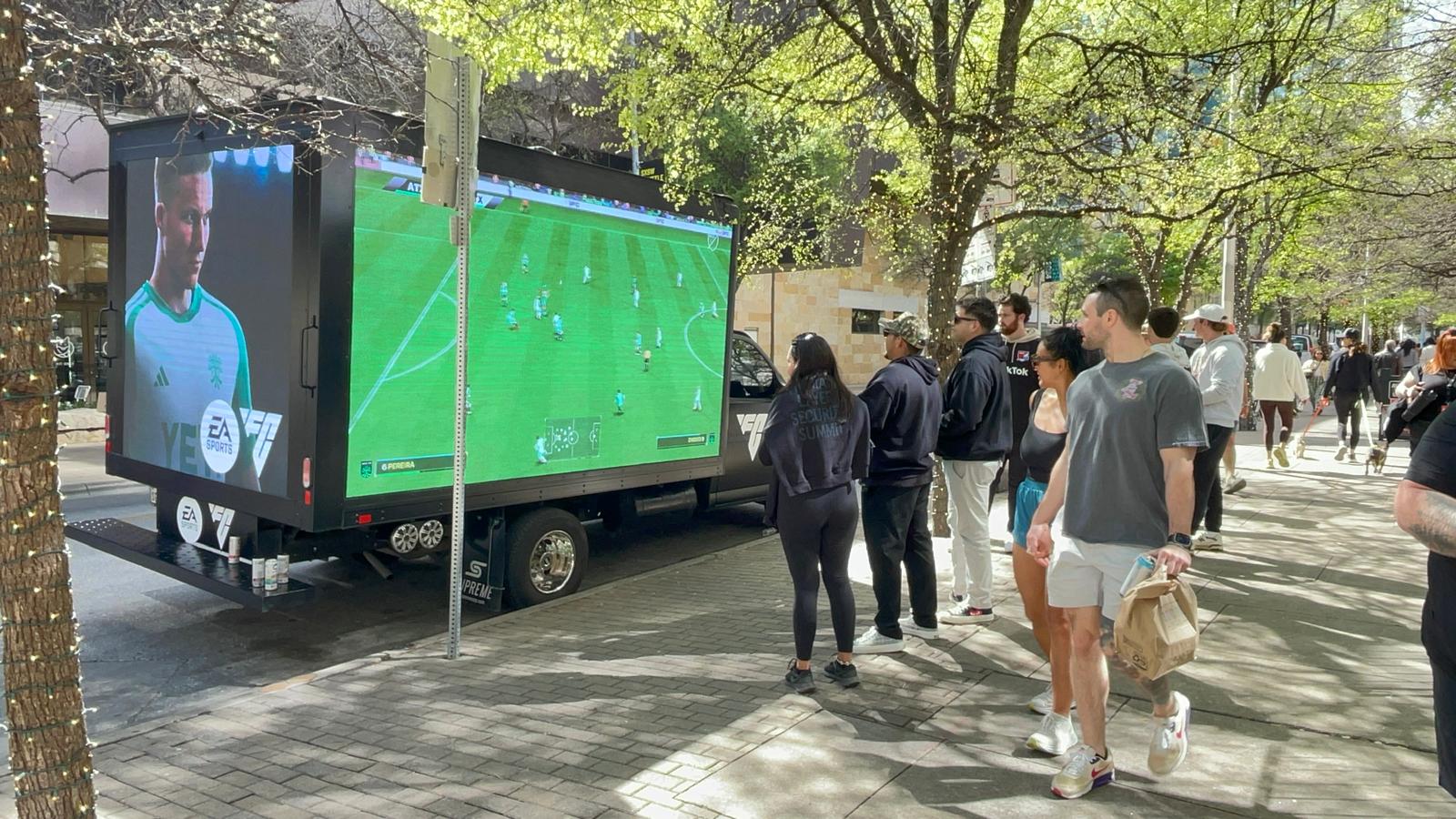
FIFA (World Cup / major matches)
FIFA is less one week, more multi-city / multi-week movement—which makes mobile especially relevant.
Where trucks win
- Stadium districts + fan festivals
- Transit corridors between match hubs and entertainment districts
- Tourist landmarks crowded with visiting fans
Best uses
- City hopping: move spend to the next match city without rebuilding inventory
- Fan zone domination: concentrate around official viewing areas and public gatherings
Many OOH planning guides for FIFA explicitly include mobile billboard trucks for stadiums, fan festivals, and entertainment districts.
Formula One (especially street circuits like Las Vegas)
F1 is premium, concentrated, and often politically sensitive. It’s also a pedestrian spectacle, which changes how mobile signage performs.
Where trucks win
- Ped-heavy corridors near grandstands, bridges, and viewing choke points
- Hospitality entrances, high-end hotel corridors, luxury retail arteries
- Off-circuit nightlife and brand events
What to watch
Vegas has been actively regulating mobile billboards on/near the Strip, including ideas like lane restrictions, caps, and brightness/sound limits.
This doesn’t kill the tactic—it just means your vendor and permits matter a lot more.
The Oscars (Los Angeles)
The Oscars are a different beast: celebrity, controlled zones, and strict city enforcement.

Where trucks can be effective
- Legal driving routes near high-foot-traffic areas adjacent to Oscar-week events
- Brand activations and permitted private-property staging
- Hotel corridors and pre-/post-event gathering zones
Measurement: how you prove impact without pretending it’s search ads
Mobile trucks aren’t last-click machines. But at major events, you can measure effectiveness credibly with a layered approach:
1) Exposure + dwell proxy
- Route logs + GPS traces
- Known choke points and traffic holds
- Pedestrian density overlays (when available)
2) Digital lift signals
DOOH has a well-documented relationship with mobile actions (searching, visiting websites, social activity) after exposure. OAAA has published findings showing a large share of mobile users taking actions after DOOH exposure.
3) Geofencing and retargeting (when privacy-compliant)
- Build event geo-fences (fan zone, hospitality, hotel cluster)
- Retarget exposed device pools with sequential messaging
- Measure incremental lifts vs control geos
4) Real-world outcomes
- Footfall to activation sites
- Promo code redemption by zone/time
- Store/venue lift during route windows
The trick is not to promise perfect attribution—promise confidence through triangulation.

Creative rules that separate “premium” from “annoying”
Major events are visually saturated. Your creative must be event-grade:
- Big type, fewer words (your viewer is walking, driving, or filming)
- High-contrast design and bold iconography
- Time-based creative (pre-game hype vs post-game celebration)
- Localization (“2 blocks → ___”) for conversion moments
- Content capture cues: build frames people want to record
If your creative looks like a banner ad got stretched onto a truck, you’ll get the results you deserve.
The unglamorous part: legality and operational risk
Mobile truck effectiveness lives and dies on operations:
- Local ordinances can restrict parking, idling, sound, brightness, lane use, and where/when vehicles can operate (LA and Las Vegas are good examples).
- Permits may be required for stationary activations, special event staging, and amplified audio.
- Brand safety: you don’t want your logo stuck in a traffic fight with police, neighbors, or a viral “this is obnoxious” clip.
A good vendor is not the one with the brightest screen—it’s the one with the cleanest compliance playbook.
So… are mobile digital billboard trucks “worth it” for major events?
Yes—when you buy them for what they’re best at:
- Precision dominance around event gravity
- Flexible routing that follows the crowd
- Exclusive share of voice in the noisiest week of the year
- A bridge between physical presence and mobile action
They won’t replace static billboards, transit, or place-based networks for scale. But for major events—where attention is concentrated and movement is predictable—mobile LED trucks can be one of the most efficient tactical OOH tools in the kit.
About LED Truck Media
LED Truck Media is a leading provider of mobile digital billboards, experiential activations, and hyper-targeted OOH solutions operating across the United States, Europe, and Australia. With a fleet of advanced LED trucks and digital bikes, the company delivers high-impact campaigns that combine mobility, visibility, and real-time consumer interaction. LED Truck Media partners with global brands, agencies, and organizations seeking innovative, measurable ways to reach audiences where it matters most.
For more information, visit https://ledtruckmedia.com/services/experiential-advertising
LED Truck Media is an advertiser with OOH Today


- Advertisement -

